Wednesday, March 11, 2009

Cinderella or Cyberella?

(sorry about the deleted post. i think i have it figured out now...)

I will be reviewing Cinderlla or Cyberella? Empowering Women in the Knowledge Society, edited by Nancy Harkin and Sophia Huyer. According to the back cover, "each essay in the collection depicts ways in ICTs provide opportunities for women to improve their incomes, gain awareness of their rights, and improve their own and their families’ well-being. Illustrative case studies from Africa, Asia and Latin America, show the global possibilities for women’s empowerment through ICTs."

I will be interested to see how the authors/editors define "knowledge society" and to read their discussions on not only women and computer and internet use, but the use of cell phones and community radio as well. While I chose this book, partly, for its title alone, I think this will also be a really interesting and informative read.

Public hearing on Obama's broadband plan

There was just a hearing on Obama's broadband plan on how the $7.2 billion in loans and grants will be disbursed. The conclusion: we do not know how to do this. About 2,500 people participated via web video and had the opportunity to ask questions, like how will this help the under-served populations? One issue I'd like to see address is the issue of the monopoly on telephone line as some companies like Verizon still require them for service, but may not be able to provide internet because AT&T has the monopoly of the phones lines in particular areas. Seems like a violation of the Ma Bell legislation, but I could be mistaken. In any case, this article gave a brief overview of the hearing and some of the problems associated with trying to disburse funds in a timely fashion.

Obama on Public Education

The LA Times posted an article today on Obama's first speech as President on public education. The speech was given to the U.S. Hispanic Chamber of Commerce in Washington on Tuesday. Many of the issues and rhetoric discussed in class are present.

The Chicago Sun Times article includes the press release, "Fact Sheet: Expanding the Promise of Education in America."

MSNBC video of the speech.

Tuesday, March 10, 2009

Digital Capitalism

I would like to do my book review on Digital Capitalism: Networking the Global Market System, by Dan Schiller. The book discusses the political-economic transition of a large number of networks originally created by government agencies, military contractors and educational institutions towards serving corporate users. This transition moved the Internet towards "digital capitalism." With the use of trade and business reports, Schiller shows that because the Internet is so closely linked with capitalism, it works to enforce and worsen social inequality.
The book is divided into 4 parts: Parts I and II focus on the policies that control the telecommunications system and the corporations they benefit--meanwhile intensifying social inequalities. Part III shows how cyberspace provides tools used for promoting consumerism across nations, and Part IV reveals that digital capitalism has already overtaken education. It sounds very interesting.

Grown up Digital


I will be reviewing Grown up Digital by Don Tapscott. I passed it up for some other books originally but after taking a closer look I think it could be very interesting. The book is about how the "Net Generation" has and is changing society as a whole. There are three main sections in the book dealing with defining the "Net Generation", how they are changing institutions like education and the workforce, and how society and citizen engagement have been changed.

I also considered reviewing Digital Nation: Toward an Inclusive Information Society by Anthony Wilhelm but I was unable to find a copy.

Technology and Social Inclusion


I will be reviewing Technology and Social Inclusion: Rethinking the Digital Divide by Mark Warschauer. The back blurb states that Warschauer seeks to move beyond the simplistic have/have-nots binary to explore the different ways that people access and utilize information and technology. This book is international in scope in that Warschauer looks at cases in Brazil, India, China, and Egypt as well as the United States. The book looks at four different types of resources: Physical, Digital, Human, and Social in addition to looking at modes of access and the interaction between the economy, society, and technology. I am interested to see how Warschauer addresses the digital divide in developing countries with such powerful economies.

Freedom of Expression: Resistance and Repression in the Age of Intellectual Property


the topics of my blog posts have often veered in this direction, and hopefully the big-ol' book review/report will be the culmination of such mental meanderings.

i plan on reading Freedom of Expression: Resistance and Repression in the Age of Intellectual Property by Kembrew McLeod. this popped up in an amazon search while i was purchasing Lawrence Lessig's Free Culture (highly recommended) as a gift for a family member (Lessig wrote the intro).

i'm still sorting out the myriad ways that the corporate locking down of intellectual property (copyrights, trademarks and such) overlaps and intersects with the digital divide, but making any content less free of proprietary restraints can easily bee seen as a hinderance to closing the digital divide.

i have yet to crack the book, but i'm pretty sure (if the reviews are any indication) that this is going to be a very enlightening read and that viewing it from the context of this class will produce rewarding results.

Book for review


I'll be reviewing The Digital Divide: Standing at the Intersection of Race and Technology by Raneta Lawson Mack. The book is divided into three sections, Exploring the Reasons, The Impact of the Digital Divide, and Solutions to Close the Gap. Published in 2001 it might well already be hideously out of date, but I'm interested to see how Mack covers a wide range of issues related to race and the digital divide.

Monday, March 09, 2009

Book Review

I plan on reading Alison Armstrong's book, The Child and the Machine: How Computers Put Our Children's Education at Risk. I think that it will be interesting to read a book the questions the impact that technology has on children in an elementary school environment.

Reading a little bit about the book, Armstrong presents multiple arguments about how technology may take away from other areas of public school funding, how it augments the traditional educational method, and the idea of computer literacy.

I think that it should be a good read. If only I had a Kindle 2 to download it on right away...

Book For Final Review Project


The book I have chosen for the final review project is Achieving Diversity: A How-To-Do-It Manual for Librarians, by Dewey & Parham. While this book does not entirely focus on digital issues, it does have a chapter devoted specifically to the digital divide. Other issues it addresses are creating a diverse library staff and tailoring your collection to meet the needs of diverse patrons.

I'm particularly interested in this title it because it provides some relatively concrete ways to act on the problem at a small scale level.

For this project I also considered Digital Inclusion: Teens, and your Library: Exploring the Issues and Acting on Them (2005), Farmer. I'll bring it to class if anyone wants to focus on youth issues and would be interested in picking it as their book (right now I have it check out from the Madison Public Library System).

"Who Controls the Internet?" - Goldsmith and Wu


"Who Controls the Internet?" is the question informing this 2006 title - recently updated in 2008 - from noted legal/Internet scholars Jack Goldsmith and Tim Wu. The book lays out a compelling case for the fact that the notion of the Internet as an unfettered Great Equalizer being less than accurate, and for the institution itself being a dynamic point of tension and subject to national, geographic, political and technocultural barriers. These artificial divides, imposed on a technology typically touted as borderless and agnostic in terms of cultural and other barriers, have many real-world implications for millions of people across the globe.

I am excited to delve into the narrative of many important precedent-setting events and cases. Many of the incidents this books reports on are included in the Cyberlaw course here taught by Anuj Desai, so I am looking forward to focusing on the background and the implications for the cases and the decisions made.

Additionally, I am looking at a book called Access Denied while I read "Who Controls...?".

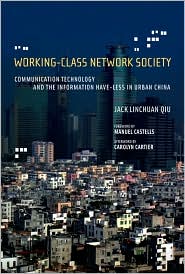
Working-Class Network Society


I will review Working-Class Network Society: Communication Technology and the Information Have-Less in Urban China by Jack Linchuan Qiu.

Qiu breaks down the dichotomy of the information "haves" and "have-nots" by introducing the information "have-less." He defines this group as "migrants, laid-off workers, micro-entrepreneurs, retirees, youth, and others, increasingly connected by cybercafes, prepaid service, and used mobile phones" (MIT Press website). He goes on to discuss how China's economy is being affected by the introduction of inexpensive technology and the "network labor" of the new working class.

Sunday, March 08, 2009

Generation Digital

I will review Generation Digital: Politics, Commerce, and Childhood in the Age of the Internet by Kathryn C. Montgomery.

In this book Montgomery looks at the so-called "digital generation" and the different ways they are viewed by adults in our society ("bold trailblazers and innocent victims, as active creators of digital culture and passive targets of digital marketing").

Stuck in the Shallow End


I will review Stuck in the Shallow End: education, race and computing by Jane Margolis.

The book focuses on the technology curriculum of three high schools in the Los Angeles metro area. Margolis is a Harvard PhD,who is currently at UCLA's School of Education and Information Science department. A chapter from this book was included in our previous readings. I was intrigued by the the author's treatment of technology education and students of color and decided to delved deeper into these issues.

Saturday, March 07, 2009

Book Review Selection


For my book review, I've selected Jane Margolis and Allan Fisher's "Unlocking the Clubhouse: Women in Computing." I enjoyed the excerpt on East River High that Margolis wrote and decided to find something else that had to do with education. This book looks at why women continue to be underrepresented in tech fields, either in schools or in the workplace. I haven't started it quite yet but it seems pretty interesting. The book specifically looks at two areas: why interest in technology seems to fade as girls reach middle school and why those female students who do enroll in tech programs at colleges/universities are less likely to stay with the major and get jobs in the field. Part of their research was conducting interviews with about 250 women enrolled in the computer science program at Carnegie Mellon. I'm excited to read it!

we choose to disseminate culture.


over at torrentfreak there's a really good response/commentary to the fan subtitling issues i brought up the other day

Fansubbers Are Not Thieves, But Avid Consumers

the issue at hand is not that people are not willing to pay for their movies, but that the crowdsourced subtitles areable to satisfy viewers much quicker than the corporations are able to provide the language specific content.


"We could be killing, we could be stealing. But no. We choose to disseminate culture. The subtitles we make are not what makes DVD sales fall, it’s their abusive high prices.

The long delay between the airing of a series in its country of origin and the rest of the world is the number one reason why people choose to download - the wait for the series to reach non-cable TV can take years!

Years to find out what happened with: The island people! Jack Bauer! Hiro Nakamura! Michael Scofield! True fans always try to buy the original products and many series owners got to know about these through the Internet. Today they are collectors."

Friday, March 06, 2009

"The Wisdom of the Chaperones"


talking about wikipedia and the percentages of users got me thinking about this slate article from a while about a year ago:

The Wisdom of the Chaperones

the idea that 1 percent of the wikipedia users are responsible for almost half of the overall content is somewhat distressing. as the article points out, the trend continues when expanded out to include other so-called democratizing web 2.0 technologies such as digg.

"Despite the fairy tales about the participatory culture of Web 2.0, direct democracy isn't feasible at the scale on which these sites operate."

"Digg and Wikipedia would do well to stop pretending they're operated by the many and start thinking of ways to rein in the power of the few."

My Book - Digital Disability


I'm planning to read Goggin & Newell's Digital Disability: the Social Construction of Disability in New Media.

These two are working in the Australian context, but their work has been the best I've seen in analyzing how new media culture and policies reinforce differences in ability, excluding those commonly regarded as having mental or physical disabilities as well as those who are "disabled" in the context of digital technology due to their inability to use the very specific tools that are required. I've only read their article on mobile phones, so I'm very excited to read the book!

Since Americans with disabilities go online at roughly half the rate of Americans who do not identify as having a disability, understanding the cultural and societal context for these differences would seem to be important in bridging that particular digital divide.

Finally, I look forward to the alliterative possibilities - Double the Digital Disability Divide!

Grooming & My Book


I imagine Facebook will continue to be the subject of study in the years to come. Here's an interesting, short article that uses science to analyze Facebook interaction. It's the neocortex divide.

Also, I'm going to read the book Virtual Inequality: Beyond the Digital Divide by Karen Mossberger, Caroline J. Tolbert, and Mary Stansbury. I liked their model in the reading we did a few weeks back, creating a hierarchy or sorts, access, skills, economic opportunity, and democracy. It looks like they break the chapters down this way too, devoting a chapter a piece to each categorical divide. They also end with a chapter on opportunities to close the divide in the future, so I like it's organization, its symmetry. Now all I have to do is get reading. Oh, and a drawback of having the Kindle version is that it doesn't have page numbers, which I'd like to have for citation purposes, so I've got this print version too, sooo old school.

Thursday, March 05, 2009

12 “Dead Technology” Advertisements


we've been talking a lot about ads for technology, and this popped up over at neatorama, so i will share it since that is what the internet does best

dead tech ads

minidiscs and beepers and neo-geo, oh my!

note: i'm not quite sure how john updike's death relates to this.

"Each of us is a minority of one"

Kenneth Starr made the argument today in the California Supreme Court that the fundamental rights embodied in the California Constitution are subject to the will of the majority, and that thus the protections offered to minorities via the constitution are subject to amendment and curtailment based on popular vote.

Quote: "Each of us is a minority of one".

Hmm..talk about making issues of race, class and sexuality invisible.

http://www.calchannel.com/

RaceFail 2009

If anyone is curious about the LiveJournal/sff fandom race discussion mentioned in class, rydra_wong has been posting link roundups for a while now. Here's the original overview, which covers the early stages of the debate.

Edit: Actually it looks like that second link I posted covers discussions of race in fandom generally. Still interesting, but less specific.

"Anti-Piracy Action Closes Yet More Fansub Sites"


we mentioned content translations briefly today, and it made me think about this story from torrent freak about fan-subtitling sites from around the world getting shuttered.

Anti-Piracy Action Closes Yet More Fansub Sites

i'm not entirely certain of the content transactions that take place vie these sites, but it seems apparent that all they're doing is providing a crowd-sourced collection of subtitles and not actually linking to any copyrighted video content, though this isn't to say that the subtitles aren't copyrighted (they most certainly are).

there's no way i'm going to be able to make sense of this site, but i'm pretty sure it's one of the sub-titling sites that is still up and running.

Anthropological Introduction to Youtube

http://mediatedcultures.net/youtube.htm

Wednesday, March 04, 2009

Reading Race Online: Discovering racial identity in Usenet discussions (article summary)

The author, Bryon Burkhalter, first tries to establish a working definition of race. It is described as “a biological phenomenon in which societies invest social meaning.” Determining racial identity of others usually relies primarily on physical characteristics of other individual such as skin color and vocal patterns. He states that knowing someones race is useful because “it provides for stereotypical understandings based on a racially immutable body” and that “it's a reliable social resource.” Burkhalter maintains that online racial identification is not lacking even with the removal of physical cues and that “racial identity is a feature of many online interactions.”

For his research, Burhalter primarily focused on several Usenet groups that were centered around racial culture. Users in these groups often self-identify through several different means including stating their racial “category”, by using vernacular expressions, as well as mentioning their parents, heritage, hometown etc. Burhalter has determined that users of these forums identify themselves in an organized way through their ongoing discussions. Rather than online users being unsure of each others races while in communication online, he believes that users are certain of each others racial identities and that in general do not indicate they are unsure or distrustful of each other. Cues to racial identification are carried along with the users stated “perspectives on racial issues.” One outcome of this physical disconnect is that if another user makes a statement which another views as a discrepancy, the reader can adjust their view of the identity of the other user to fit their perspective.

The author then gives a short description of what Usenet newsgroups are. He states that Usenet resembles a “large cocktail party.” Here is a link to a FAQ on Usenet: http://www.faqs.org/faqs/usenet/what-is/part1/

Some users take the physically anonymous online opportunity to claim a racial identity other than their own. It seems in most cases however that participants are more concerned with being known and in how they are received than in deceiving others. Specific cultural, racial, or ethic terms are sometimes used in subject lines when bringing up a specific topic for discussion to assist in framing the conversation towards a specific audience although this does not assure that race will be relevant though the course of the discussion comments.

Sometimes asserting a specific identity can be disputed and anonymous messages can “undercut the credibility of an author's identity and argument”. In some cases rather than attacking a user's argument, their “claimed social position” is attacked which deflects from the actual discussion of their view. Stereotyping online can work in an almost reverse way from “standard” stereotyping. Rather than determining someones beliefs by their race, one might use someones beliefs to help determine a persons race in an online interaction. Race is still relevant online and stereotypes flourish in Usenet environments.

Free Press Documentary Series on Broadband Internet

Free Press went to North Carolina recently, and interviewed people in rural areas about how their lack of access to broadband internet service was hurting their economic opportunities and connection to the outside world.

Very interesting stuff, connected to the Internet for Everyone project, which advocates for broadband expansion as a necessary service, like water or telephony.

Monday, March 02, 2009

Upcoming lecture of interest (right after class!)

While putting together next week's campus events digest, I came across this lecture up in Social Sciences. Anyone up for a brown-bag?

THE EFFECTS OF HOME COMPUTERS ON EDUCATIONAL OUTCOMES

WHEN AND WHERE: Thursday, March 12, 12:15 p.m., 8417 Sewell Social Sciences

DETAILS: Robert Fairlie, University of California, Santa Cruz, will discuss his research on the digital divide, welfare reform and the U.S. educational system, featuring evidence from a field experiment with low-income community college students.

RELATED LINK: http://www.lafollette.wisc.edu

CONTACT: 608-262-3038, shelton@lafollette.wisc.edu

Sunday, March 01, 2009

Conference on Social Justice

I just received a notification about a conference on social justice sponsored by several students in the L&S Honors Program on campus. It will be held April 24-25. Considering our conversation last week on the disparity of technology between departments, not to mention issues of equality and equity, I thought some of the class may be interested in attending and/or participating in the forums.

Friday, February 27, 2009

Bad news for those with impaired eyesight

After numerous publishers expressed concern over the text-to-speech feature on the Kindle 2, Amazon is backing down and letting the copyright holders decide which texts will have this feature enabled.

On Being Middle Class

Both the Kahlenberg (2005) and Margolis (2008) articles made frequent reference to socio-economic status. Kahlenberg (2005), in particular, spoke of middle-class students however, he failed to define its meaning. As Sarah R. mentioned, in class, - millions of Americans (U.S.) held “good jobs” working in factories or in the civil service. These individuals can make 40-50k+ a year; times two and you have a household income approaching 100k a year. Such individuals would certainly be middle-class on paper but may not necessarily have a professional, white-collar ethic when it comes to academic rigor and or higher education. Therefore I can only infer that the middle-class Kahlenberg (2005) references are those with college educations rather than well-paid blue collar workers. It is important to be clear on such things.

Thursday, February 26, 2009

Lunch Divide

The expanding lunch divide. Well maybe this can help with the obesity problem, you know, try to think positive. They could at least make it a grilled cheese sandwich, that was one of my favorite lunches in school.

Articles from today's class

Here's the New Yorker article about finding the best teachers that Alex brought up in class.

Also, here's the NYT article on the humanities having to justify their existence (again...) mentioned by Katie.

Wednesday, February 25, 2009

Readings for Feb. 26

I am the lone standard-bearer this week. Apologies for the length!

Kahlenberg discusses how school segregation is making inroads again, not only in cases of race and ethnicity but class. In many cases, this involves both geography and ethnicity in combination with socioeconomic class. He points out that “classmates are a resource, too – in fact, a more crucial one than books, pencils and laptops.” Race was not a defining factor, but better preparation and higher aspirations were.

In some ways, being around more affluent/more prepared classmates could be seen as a form of experiential learning. Increased exposure to words and ideas from fellow classmates is perhaps more important than what a student learns from a teacher.

Several factors have aided in school improvement across the country. Most indicators of quality schools are found in mid-and-higher-income schools than those from more impoverished areas. Achievement is highest in middle to higher income schools, which attract the best teachers so lower-income students may need to be mixed into mid-and-higher income schools to simply gain access to better teaching. Parental involvement in classroom and extracurricular activities also plays a role in improving student achievement. Again, socioeconomic status predicts parental involvement.

The No Child Left Behind Act has also reinforced the notion of segregation by placing the emphasis on test scores. While it claimed that failing schools would be overhauled and improved, little action has taken place. Meanwhile, families pondering a move can use the much-publicized test scores as a reason to not move into a school’s attendance area, thus reinforcing a school’s negative reputation.

In short, Kahlenberg sees not one educational system in America but several – systems catering to different segments of the population, incomparable with each other.

Margolis describes East River High school as a place where the tools existed but without any indication of how to use them. In one situation where a class was actually offered, the teacher had trained himself at home. This directly contrasts one aspect of what Kahlenberg cited: the best teachers are allowed to teach in their own area of expertise.

Kahlenberg describes how students learn best from being within the context of their peers. Though he does this in reference to lower income students learning from students with higher aspirations, the same holds true for the computer science students in Margolis’s article: the ones with the most interest were recruited by friends.

The failure can be blamed in part on a lack of critical thinking and context that shows how actual computer science programming can make a real-world impact. The East River curriculum, what little there was, focused on skills rather than critical thinking concepts. In contrast, note how the video production classes that allowed the students to not only manipulate the data but create scripts and storyboards allowed the students to expand their horizons and think critically while learning skills.

Again harkening back to Kahlenberg’s expectation of a good teacher or curriculum, the best schools offered rich, demanding curricula. East River was in no way prepared to offer any curriculum beyond the most basic. Because of both student and teacher scheduling, East River could only focus on attempting to meet the state- and federally-mandated testing standards, not the more specific electives like computer classes. Moreover, even the most dedicated teachers expected very little from their students, relegating them to less demanding work with very little guidance. When East River DID offer more guidance through extracurricular math classes, the students displayed both interest and perseverance.

In both Kahlenberg’s and Margolis’s articles, they imply that the problem of equity is one that cannot be solved by anything less than a comprehensive change to the way we place students together. Students need to be around people (classmates or staff) who encourage them to attain higher goals, regardless of background.

Moreover, entire families bear the burden of lower expectations. It’s not just vocational vs. college prep courses in school; think of the fact that lower income families are less likely to take advantage of private school voucher programs, perhaps because they are less likely to trust any part of the “system” that has failed them thus far.

Facebook and Wisconsin Schools

"School Library Journal: Extra Helping" recently reported that "WI Schools Ban Facebook, IM Fraternizing Between Staff, Students". The school district is Elmbrook (Brookfield, WI; near Milwaukee), and this ban is on non-school hours communication. Facebook and MySpace are blocked during the school day.

What do you think about this attempt to control the means by which teachers and student may communicate?


Tuesday, February 24, 2009

National Assessment of Adult Literacy

I was discussing this resource in class a couple of weeks ago, so I thought I would share it. The website summarizes the study nicely:

"The 2003 National Assessment of Adult Literacy is a nationally representative assessment of English literacy among American adults age 16 and older. Sponsored by the National Center for Education Statistics (NCES), NAAL is the nation's most comprehensive measure of adult literacy since the 1992 National Adult Literacy Survey (NALS)."

(from http://nces.ed.gov/naal/)

I really enjoyed reading about the complexities of assessing literacy and establishing research methods in their discussion of "Indirect County and State Estimates of the Percentage of Adults at the Lowest Literacy Level for 1992 and 2003" (http://nces.ed.gov/pubsearch/pubsinfo.asp?pubid=2009482).

But the part that I enjoyed playing with was the model that this document describes. It allows comparisons and estimates of low literacy rates by state and county. Basically you can compare two states or counties and it will show you the proportion of the population below a basic literacy rate (with the standard deviations of the stats). It's just a nice interface with which to browse the statistics.

See http://nces.ed.gov/naal/estimates/ for more info and to play with their model.

Monday, February 23, 2009

Kindle!

Once again, an article on the Kindle. Alex, when you get it you'll have to let us know if all the hype is true!

Saturday, February 21, 2009

Live Global

Could programs designed to change the digital divide be implemented overseas, but grown here?

Thursday, February 19, 2009

Think Local

Here's a link to the Madison Public Library's services and some statistics about the Madison Metropolitan School District (MMSD).

Information and Equity

Lievrouw and Farb's “Information Equality,” which appeared in the 2003 ARTIST, is a review of research “on information and social equity and on the digital divide” (500). Most of the chapter is dedicated to the discussion of differences between the vertical perspective and the horizontal perspective, but the authors conclude by proposing that the two perspectives work best when combined. Then, they present five factors that “should be considered in any evaluation of information equity” (527).

According to the authors, the vertical perspective contains the earliest (1949; p 506) and the bulk of the research done on information equity. In this school of thought, information is a commodity, and a person's access to and use of information is the indicator of equity. With this perspective, information equity can be achieved through even distribution of goods.

The horizontal perspective, which evolved more recently out of criticism of the vertical perspective (515), focuses on information as an “intangible public good that is highly subjective and context dependent” (501). It emphasizes a person's ability to use information to meet their desired goals as the indicator of information equity. With this perspective, education, social capital, and context all play a part in achieving equity.

The authors seem to favor the horizontal perspective, but the five elements that they propose at the end of the chapter do include the vertical perspective; they list as their first element “a more even distribution of information resources in society” (528). The remaining elements focus on education and context. Overall, this article does a good (brief) job of explaining the history of information equity research, and, with the five suggested elements, how libraries should proceed. The class might consider how successfully the elements have been adopted by information agencies though identification of concrete examples (or by using examples offered by Slytherin?).

Wednesday, February 18, 2009

Redefining the Digital Divide

In “Redefining the Digital Divide,” Mossberger, Tolbert and Stansbury try to redirect the conversation of the digital divide by examining aspects other than access to technology. Mossberger et al believe that by concentrating primarily on access to technology, most studies have been unable to pinpoint both the causes and potential solutions to the divide. In their study, the authors define the divide as being four different, but interlocking, divides: the access divide, the skills divide, an economic divide, and a democratic divide (2).

This chapter, which is the first of a book, traces the public discussion of the digital divide and the various ways it has been studied. After the Internet became a public utility, as opposed to a military and academic tool, it was quickly recognized that some were being left behind. The Telecommunications Act of 1996 was the first federal law to include internet access in addition to telephone service; this helped to establish the problem as one of access. However, the authors argue throughout this chapter—and the rest of the book—that the problem is much wider. Access, they argue, is not important unless people have the skills to use, evaluate, and understand both the technical, social, economic, and political dimensions of the technology.

The authors note that in both research and programs created to address the digital divide, the emphasis has been almost solely on access, not on information literacy, the role of technology in society, the potential uses of technology for the economically disadvantaged, or how technology functions within our system of government. In 2001 the E-Rate program provided almost $2.25 billion dollars for infrastructure, while only $110 million was spent on all programs that focused on skills development (3). The majority of funding for projects on the digital divide comes from the federal government, and during the Bush administration, there was increasing debate on whether the digital divide would heal itself.

One of the ways this study differs from others done in the past was their methodology. The question set was broader, addressing all four aspects of the divide as defined by the authors. Samples focused on residents of low income areas, and “low income” was defined as $30,000 or less. For the surveys the divides were broken down as such:

Access divide: interest in a computer, location of access, and frequency of use
Skills divide: technical competence and information literacy
Economic opportunity divide: beliefs about the connections between technology and economic
advancement
Democratic divide: attitudes toward the use of technology in political activity

To analyze their results, the authors use multivariate regression, which allows them to analyze different variables and explain their role in the digital divide. The authors have a commitment to presenting their information in ways that is understandable to those without a backgrounds in statistics. The authors conclude by outlining their plan for the rest of the book and providing rough sketches of each chapters, including the policy suggestions they put forward towards the end.

Tuesday, February 17, 2009

Beyond Access: Psychosocial Barriers to Computer Literacy

In Beyond Access, L.D. Stanley examines the argument that cost and access are the primary deterrents to computer literacy. She does so by examining computer usage statistics of new users and nonusers at community technology centers and adult education centers in San Diego, CA. Through an ethnographic study, Stanley reveals that the underlying psychosocial elements of relevance, fear, and self-concept act as substantial motivation barriers to computer literacy.

Stanley found that nonusers often cite cost as an issue rather than addressing the underlying psychosocial barriers to computer literacy. Misconceptions about computers often led to nonusers rejecting them as personally relevant rather than making informed decisions about computers in their lives.

Self-efficacy prevented many from using computers, either due to fear of appearing foolish or fear of doing irreparable damage to the machines themselves. The anxiety and embarrassment that potential users felt over their computer illiteracy transcended divides of gender, education, and age (411).

Cultural identity and self-concept influenced individuals' perceptions about their relationship to computers and corresponding computer literacy rates. Stanley's research suggests that the acquisition of computer skills is directly correlated to an individual's ability to visualize herself as the type of person who uses a computer (412).

In the end, Stanley advocates for outreach efforts that underscore the plethora of economic and social advantages that computer literacy can provide. In order to be effective in breaking down the psychosocial barriers of relevance, fear, and self-concept, outreach efforts must be executed in culturally appropriate ways. By shifting the focus from access to outreach, Stanley believes that communities will be more effective in bridging the digital divide.

A Framework for Understanding the Digital Divide

In chapter two of The Deepening Divide, van Dijk presents his argument that a better framework is needed to study and understand the digital divide. He feels that the current research methods lack conceptual clarity and in-depth analysis. Basic concepts like access are poorly defined and many of the studies done focus too much on demographics and individuals while leaving the reasons of why and how to conjecture.

van Dijk argues that a more relational view is needed to study the digital divide. With a relational approach, the focus can move away from individual differences and toward positions and categories of groups. This would allow the relationships and interactions between these groups to be studied in greater detail. A more relational view would also help differentiate between different types of inequality and tie together the differences between groups/positions into a continuous spectrum.

To create a more relational framework, van Dijk first forms a more defined theory of the digital divide. The five core parts of van Dijk's theory are 1) Categorical inequalities produce unequal distribution. 2) Unequal distribution causes unequal access. 3) Unequal access also depends on types of technologies. 4) Unequal access brings unequal participation in society. 5) Unequal participation reinforces categorical inequalities. Using this theory, van Dijk constructs his framework which is based on a causal and sequential model of access.

The diagram on page 24 illustrates the core parts and how they interact. The five key categories of the framework are Personal Categories, Positional Categories, Resources, Participation in Society, and Access. Each category is then further broken down into specific concepts or relationships.

Personal categories deal with inequalities that are more inherent like age, sex, and intelligence. Positional categories are based on position in society like employment status or education level. The Resources category deals with resources a individual or group has to draw upon. Resources like temporal (time), mental (skills), and social (relationships). The access category is broken down into five concepts related to technology access. These include motivation access, material access, skills (digital and operational), and innovation. All together, these four categories interact to affect the fifth and final component of the framework, Participation in Society.

In the future, van Dijk plans to study and test each section of his model. When each category and concept is defined and the gaps in it filled, he plans to use his framework to build a better understanding of the digital divide. He hopes this will help address some of the shortcomings of current research and form a more empirical and methodological study of the digital divide.


Zuckerberg's vision of Facebook in the future

Mark Zuckerberg talks about his vision of Facebook in the future in this CNN/Fortune 500 article. According to him, Facebook will hopefully become the standardized medium for communication in the future. A "Facebook ID" will allow you to search, identify, and contact specific individuals. In my opinion, Zuckerberg's idea could be called "Phonebook 2.0"

The eldery getting connected

Here is a NY times article I found that looks at the troubled economy, senior citizens, and computer literacy. Given our discussions and the statistics we looked about computer skills and senior connectedness, I thought it might be of interest to some of you.

Monday, February 16, 2009

Just some humor...


Sorry it's something of a messy scan, but if you click on the picture itself it'll show you a more legible version. I took it with my cell phone camera, emailed it to myself, and cropped it on my laptop. Which leads to another interesting issue of the breakdown of the barriers between the physical and the digital world.

That thought leads me back to the comment from class, that the digital divide is both reflective of static sociocultural divisions, but also an evolving creature, as the technologies themselves evolve. In other words, while there are unquestionably still barriers and segregation in the digital world, these barriers are themselves changing and evolving along with these technologies.

click the pic to get the (frighteningly elaborate) joke!

i would HATE (read: LOVE) to harp on the recent ebooks issue longer than need be, since we've moved on a slight bit, but i just read an essay, well, a transcription of a presentation, by cory doctorow titled "ebooks: neither e, nor books" (from the collection content) which wraps some of the issues i raised in the steve harvey post over the weekend very nicely with some of the general perceptions of ebooks, and as such, i am not prepared to let this die just yet.

interestingly enough, in making his books freely available through a creative commons license, doctorow fans have ended up translating the book into numerous languages, including braile, and there's even a collection of people reading the essays aloud for the deaf or hearing impaired, this making his (e)books more and more divide crossing, if that's a phrase we can all agree on.

cell phones in class?!

Check out the New York Times article about how the cell phone industry wants cell phones in classrooms.

Some of it sounds pretty interesting, but it also seems like a ton of extra work for teachers--and maybe these students would be better served by having those funds and that time go to something else, like healthier foods in the lunchroom or scholarships for their teachers to get more training. I've never taught, but I know some of you have and I would love to hear what your experience with cell phones were and what you think of this idea.

Article on "The future of reading" from the NYT

Interesting article today about how digital tools change the work of the school librarian:

A group of fifth graders huddled around laptop computers in the school library overseen by Ms. Rosalia and scanned allaboutexplorers.com, a Web site that, unbeknownst to the children, was intentionally peppered with false facts.

Ms. Rosalia, the school librarian at Public School 225, a combined elementary and middle school in Brighton Beach, Brooklyn, urged caution. “Don’t answer your questions with the first piece of information that you find,” she warned.

Most of the students ignored her, as she knew they would. But Nozimakon Omonullaeva, 11, noticed something odd on a page about Christopher Columbus.

“It says the Indians enjoyed the cellphones and computers brought by Columbus!” Nozimakon exclaimed, pointing at the screen. “That’s wrong.”

It was an essential discovery in a lesson about the reliability — or lack thereof — of information on the Internet, one of many Ms. Rosalia teaches in her role as a new kind of school librarian.

Read the rest of the article here.

Sunday, February 15, 2009

Literature Online

This isn't entirely relevant, but internet self-publishing is so widespread I figured I would post it. As the economy continues to kill off small publishing houses, this might be the only way a lot of art gets out there...

Saturday, February 14, 2009

you've got the whole earth (catalog) in your hands


we talked a little bit about the whole earth catalog the other day as a means of putting the whole internet catalog into some sort of context, and a few months ago they made their back issues available to flip through for free or pay a reasonable fee for downloadable pdfs.

in defense of the kindle robot voice

i started writing a comment on the kindle discussion below, and it kinda got away from me, so i thought i might as well post it as its own post since it goes off on something of a tangential direction than where the dialogue was headed.

one aspect that our discussion of the kindle articles hasn't touched on yet is that the authors guild is looking to control the way we interact with content that we have purchased.

while i agree that the idea of daft punk robots reading a books is nowhere near as good as trained voice actors or brad pitt or whatever, it misses a valuable point that should be addressed.

say you pay $9.99 for steve harvey's "act like a lady, think like a man" (no. 5 on the kindle best seller list). since you paid your money for that kindle file, why is it so wrong for a computer to read it out loud since that's something that modern technology has made possible?

the function that the kindle performs, making ebooks (more than likely legitimately purchased ebooks form the kindle store) audible, is much closer to fair use than it is to being a derivative use, and the fair use of owned content is something that is very much worth defending.

ultimately, i think the writers guild is looking for a cut of the kindle action since the kindle does something that is similar to (but not the same as) audio books. giving into them with this this cut sets up an interesting, and i believe negative, precedent which might discourage people (through threats of litigation) from inventing technologies which would translate written works into audible sounds. ultimately, we're talking about technologies that would benefit the blind and visually impaired more than anything else, and as such, fighting against this sort of ridiculous litigation is something we should be working towards.

MyWebSpace down this weekend

The UW file repository MyWebSpace went down Friday morning and apparently won't be back up until Sunday. This means that the optional readings for our class will be unavailable until MyWebSpace is restored. Let's think about this as a good example of the risks we take as we move materials to online storage managed by institutions at various scales. (More on this on my occasional weblog The Note on My Door.)

Friday, February 13, 2009

Siftables

Some interesting new "toys", has possible educational/story telling/entertainment possibilities as well as demonstrating new way for humans to physically interact with computers.


Beware, TED talks will suck you in and steal hours of your time.

More thoughts on the $99 iphone

Here is another article about the $99 iPhone and reduced plan from cnet http://news.cnet.com/8301-13506_3-10162469-17.html

I haven't really thought this through but I am at work so I am going to quick post it. Anyway, I think offering different priced versions of the same technology really widens the digital divide. On the surface it seems like it brings more technology to more people like moblie internet access, but in this case, if someone got the $99 iPhone they will be stuck using the Edge network (lets call it dial up) while the people with the $199 iPhone would have the 3G network (broadband).

Enlightening Reports from the Pew Center

Fox (2007). Latinos Online.

Horrigan (2008). Mobile Access to Data and Information

Thursday, February 12, 2009

Have you seen The Hub?

In light of our discussion today about how some people may be less inclined to use new technologies if they don't already have a foot in the door (for example, the idea that new devices like the iPhone won't increase Internet usage among non-users), here's an article I found about Verizon's The Hub, a phone that carries calls over the Internet and has a whole host of snazzy features including a video library, Yellow Pages (to check movie times, order pizza, etc.), and even the ability to track your child. As of right now, you can't check email or surf the Web but this article says that Verizon may add those features.

Also interesting that in order to use this phone, you must live in an "Enhanced 911" area. I'm wondering if this is another example of rural folks getting left on the "wrong" side of the digital divide tracks.

http://www.nytimes.com/2009/02/12/technology/personaltech/12smart.html?ref=technology

CNET may have listened to our discussion earlier today

While I was looking at CNET.com for my daily hash of tech news, I came upon an article that talked about the evolution of the internet. Take a look and review the information if you would like.  http://www.pcworld.com/article/159471-7/the_evolution_of_the_internet.html. 

kan kindle overkum?

looks like the kindle is in trouble with the writers guild which is claiming that a robotic voice reading the book you have purchased with your hard earned money is a deritive, and as such a violation of copyright.

http://blog.wired.com/27bstroke6/2009/02/copyright-fight.html

Kindle 2 vs Audio Books

Just saw this http://tech.yahoo.com/blogs/null/121556

I think I would prefer audio books over the ROBOT VOICE OF THE KINDLE TWO.
Link to the Brandt's article on literacy

$99 iPhone with Reduced Plan to Debut

$99 iPhone coming this summer

This is an industry-style analysis with a lot of interesting detail.

Wednesday, February 11, 2009

Information technologies and social equity...

Writing in 1990, Doctor provides a socioeconomic critique of the effects of information technologies on the wider society. He specifically investigates the distribution of microcomputers as an indicator of social inequality in the Age of Information and looks to public policy as a way to ensure a reduction in the growing gap between the information rich and information poor.

In his research, Doctor found two opposing themes represented in the literature, (1) information technologies, as part of larger oligopolistic system, create uneven power distributions that result in social inequities or (2) information technologies, as part of a free market, enhance social equity by decentralizing power and control through the distribution of information. For Doctor, the shift to a knowledge economy directly links information and profitability and, therefore “increase[s] contention for control of information and knowledge resources” (218).

Looking at a range of studies, including the CPS study we reviewed last week, Doctor showed that the distribution of microcomputers is correlated with various socioeconomic factors, such as income, education, race, and location. Although microcomputer ownership is a variable contributing to the digital divide, Doctor suggests that information literacy is an equally important variable when addressing the information gap.

To affect any significant reduction in the information gap, Doctor believes a democratic society’s power lies in its ability to shape public policy. He proposes a top-down approach modeled after other federal projects in his design of the National and Regional Institutes for Information Democracy. These institutes would act as intermediary networks between federal and regional government, Experimental Mass Information Utilities, and local libraries and schools. The institutes would be responsible for core hardware and software needs, as well as funding, project planning, research and consultation with the local level. For Doctor, this solution would be able to reach the most disadvantaged population through a dual system of collaboration and oversight.

Ever-Shifting Internet Population (2003)

Every few years the Pew Research Center releases a report on some aspect of Internet connectivity and the digital divide. What makes the 2003 Report, the Ever-Shifting Internet Population, interesting is that it illustrates the Internet as a boundary object as well as emphasizing the, often ignored, variation within populations. Using phone surveys, focus groups and secondary data the report focused on non-users, negotiated meanings of the Internet and the physically challenged.

58% of Americans were reported to have used the Internet; this was up from 2000 when the numbers were at 49%. However, the data suggest that since 2001 new users had become stagnant. By 2002 Internet use was predicted on being White, upper-middle class, having a college degree, student status and residence in urban or suburban communities.

African Americans (A.A.) were least likely to go online lagging being both Whites and English dominant Hispanics. When adjusted for income and education A.A.’s still lagged behind the aforementioned populations.

Southerners and Mid-Westerners, at 45 % and 44% respectively, were the largest geographical areas were citizens were off-line.


Boundary Object - Negotiated meaning:

Non users and users had divergent conceptualizations of the Internet. The overwhelming majority of non-users believed the Net is a dangerous space/ place; half thought the Internet was just for entertainment, and most did not feel they were missing out by staying offline. Interestingly 20% of non-users had no concept of what the Internet was at all.

Various types of Non Users

Net Evaders: (20%) This demographic while not using the Internet they often had access via friends and family members who searched and retrieved information on their behalf.

Net Dropouts: (17%) Users who were once Internet users but have left- usually because of have poor equipment.

Intermittent Users: (27-44%) Internet users who stopped accessing for prolonged periods and are now back online.

The physically challenged:
18% of participants self-identified as physically challenged. Only 38% of this demographic were Internet users. Many lack access to adaptive technologies and are unable to access public Internet facilities. Internet access is especially important for this population as they are more likely to search for medical information and use the Net as an entrainment outlet.

Article #1, Introduction: Computer Lib

Nelson writes a breezy and somewhat flippant introduction to a socially conscious computer text. He argues that computers are a necessary part of modern life (modern being 1974, for a little perspective) and that everyone should be computer-literate, but that there are few opportunities for people who are not to become so, and to that end he has written this book to explain the basics.

Rather than coming from a solely technological perspective, though, Nelson is writing from a tradition of social radicalism. He talks about the "computer priesthood," the tendency of computer professionals to hoard knowledge, as unique not in its existence (doctors and engineers do the same thing) but in the impact of it. Since everyone has to deal with computers, the hoarding of knowledge is a serious problem. He castigates professionalism in general in a sidebar, preferring an informed citizenry to a decision-making professional class.

The goal of his book, then, is to create that informed citizenry. Nelson objects to popular objections to "the computer," saying instead that people should object to bad computer systems, not computers in general. He wants everyone to understand computers enough to understand the way people want to apply them in policy and in daily life, so that they can react from an informed position instead of a position of technophobia.

Tuesday, February 10, 2009

No More Running

I wonder if Sullenberger could call the US government and ask for an extension on his student loans, which were also on the plane. Maybe they would wave all fees and we could uncork some champagne.

Monday, February 09, 2009

Wiki


Hi everybody. We've begun to add links on the Wiki. The subject matter covers a good range, so I'm sure there's something interesting for you to read.

Sunday, February 08, 2009

On Fear and Internet Adoption

Last week we talked a bit about fear and cyberspace technologies. In the mid to late 1990's it was not uncommon for studies to report that African Americans' slow adoption of computing and the Internet was related to a fear of Big Brother among other things. Specifically many believed that computers and the Internet were apart of a federal surveillance campaign to collect vital information about their private lives. I think it's important to consider the histories and relationships of various communities within face-to-face communicative contexts as these experiences and perceptions are often transferred into the virtual world.

See:

*Ervin, K. S., & Gilmore, G. (1999). Traveling the superinformation highway : African americans' perceptions and use of cyberspace technology. Journal of Black Studies, 29(3), 398-407.

*Kretchmer, S. B., & Carveth, R. (2001). The color of the net ; african americans, race an cyberspace. Computers & Society, 31(3), 9-14.

*Marriott, M., & Brant, M. (1995). CyberSoul not found. Newsweek.,126,(Jul 31),62-63 .

Microsoft & OLPC news

Some other links that might be of interest:

Adding to the computer ads we watched last week, here 4.5 year old Kylie shows us how it's done...the PC way: http://www.liveside.net/main/archive/2009/02/07/i-m-a-pc-and-i-m-4-and-a-half.aspx

Two articles I found on the changes afoot for OLPC:
http://news.cnet.com/8301-1001_3-10159166-92.html
http://morgancollett.wordpress.com/2009/02/06/olpc-discontinues-change-the-world/

What got cut from the stimulus bill

In light of our recent conversation, CNN reports....

Fully eliminated:
$2 billion for broadband

For full article: http://www.cnn.com/2009/POLITICS/02/07/stimulus.cuts/index.html

Thursday, February 05, 2009

Logging

I don't know how many of you have seen the South Park episode from last year called "Over Logging." It provides a funny commentary not only how people feel they need the Internet (as we talked about), but also on how it's often being used. You can easily watch their episodes at south park studios or watch the particular episode at hulu. It's season 12, episode 6, I think.

We looked at advertisements in class, but I think it's also fascinating to see how computers/technological innovation/information are presented in movies. I know Jen brought up War Games. It made me think about The Net with Sandra Bullock and many others. Can you name any others?

Also, Jen, I know you're a studied fan of sci fi/fantasy. Could one say that sci fi seems to comment on the present while fantasy seeks to escape it? Just a thought.

"internet? i'd say internet."


the mac commercials that we looked at today got me thinking about those old jeff goldblum imac commercials from way back in the day (a couple of years ago?).

youtube searches brought me to this strange meme that has apparently been going around for a little while:

drunk jeff goldblum.

enjoy.

Wednesday, February 04, 2009

Article #4 A Nation Online: Entering the Broadband Age


it's a shame that i had a conversation yesterday where i took the position that grad students didn't get senioritis, and here i am the last of my group to post-up and still putting it off for no good reason other than sheer laziness. my lethargy might have been a good thing though, since i was able to spot a thoroughly pertinent article in the interim which i might have missed had i posted earlier in the afternoon.

i was assigned the last article, "A Nation Online: Entering the Broadband Age", which was kind of a bummer at first ("i get the one that's 15 pages?! National Telecommunications and Information Administration, US Department of Commerce? boring!") but this quickly changed to elation once i realized that it was in big print with lots of graphs.

I keed! I keed!

so, the reading was basically a run down of the growth of broadband usage between Sept 01 and oct 03, as well as examine the ways that broadband users differ from dial up users. the article is broken down into four distinct sections: access & use, online behavior, the effects of geography, and reasons for non use.

in the three year window being examined, the number of households with internet grew by 12.6%, adding almost 7 million internet users to the world. the number of homes using cable connections almost doubled (from 6.6 mil to 12.6 mil), and the number of homes using dsl almost tripled (from 3.3 mil to 9.3 mil). interestingly, the number of dial up users, still the visible majority of internet users, experienced an almost 13% decrease. in short, this is a very visible sign that internet users are changing over to using broadband for their internet needs.

the online behavior section of the reading was a pretty straight forward look at the differences in the different ways that broadband and dial-up users interact with the internet. this section was broken down into its own little set of sections: communications (almost everyone uses email, regardless of their connection level), entertainment ("dial up users are more like those without the internet at home in terms of their use of the internet for entertainment"), transactions (there were obvious differences, specifically with online banking, but it's obvious that people still rocking dial-up are able to get their amazon.com on once and a while), and information, which i thought of as reference (it was around this time that a lot of the simple search sites were hitting their stride and "to google" was becoming a valid verb, so everyone was more or less using the internet to get health advice, news, weather and sports info).

not surprisingly, people who live in rural areas are less likely to have broadband than people in urban areas, especially "central cities." the reading makes some pretty valid reasons why this might be, including the lack of cable access, the higher price tag that might go with a lower subscriber base, and the limited range of dsl services from their central switching offices. very simply, the availability of broadband internet in rural areas is a road filled with many more potholes than in urban areas.

shockingly, 41.3% of all americans still don't use the internet at all, from anywhere, according to the reading. the main reasons for people not using the internet, or not switching to broadband were that they weren't interested or thought they didn't need it, and that it was too expensive.

reading this article i thought often of grand parents sitting in their recliners. they're the ones not using the internet, making up almost half of america that doesn't us the internet, right? well, probably not, but that number is still upsetting, and one that seems very pertinent given this quote regarding the recent stimulus package that features a huge chunk of money headed towards giving a lot of broadband breaks: “The first rule of technology investment is you spend time understanding the end user, what they need and the conditions under which they will use the technology,” said Craig Settles, an industry analyst and consultant who has studied broadband applications in rural and urban areas. “If you don’t do this well, you end up throwing millions or, in this case, potentially billions down a rat hole. You will spend money for things that people don’t need or can’t use.”

we've some a long way since 2003, but are there still a significant enough number of people to make a massive part of the stimulus package a "$9 billion cyberbridge to nowhere?"

Article #3, A Survey of the "Have Nots" in Rural and Urban America

The US Department of Commerce’s 1995 report presents statistics on who, what, and where the lowest percentage of “telephone penetration”, “internet penetration”, and “modem penetration” exist in the continental United States. Using the Current Population Survey (CPS) designed to determine the demographics of telephone subscribers, the National Telecommunications and Information Administration (NTIA) added questions on computer use and access, and modem ownership and use. While the CPS survey on telephone subscriptions failed to recognize geographical location in their results, the NTIA made sure to tabulate their survey results based, not only on geographical region, but also on income, race, age, and education level.

Information “have nots” were found to be disproportionately high in rural areas and central cities (the largest area or part of a metropolitan area). Generally speaking, the young and the old, minority groups, and those with the lowest income and the least amount of education, were the least connected, but surprisingly, the most likely to use these resources for “economic uplift and empowerment.”

The report concludes with some solutions to these discrepancies. The authors acknowledge that insufficient statistical data makes it difficult to know/understand why the “have nots” exist. For example, it is not clear, based on the statistics obtained by the CPS and NTIA, whether the low-income disadvantaged are also the minority, the less educated, or the young and old populations suffering from the same disadvantages. However, once these profiles are more thoroughly fleshed out, the government, at all levels, will develop support groups to remedy the problems. In the meantime, the report suggests that public schools and libraries act as “community access centers” for those communities unable to access information on their own.

Article #1 Community Information Centers

Joseph C. Donohue and Manfred Kochen, "Community information centers: Concepts for analysis and planning," in Manfred Kochen and Joseph C. Donohue, eds., Information for the community (Chicago: American Library Association, 1976), 7-18

The authors begin by outlining and explaining the “information gap” became more pronounced do to the growing complexity of societies, particularly in urban areas, and the changing nature of traditional social patterns. This led to a call to action by several educated idealists, who were trying to make sure that justice was for everyone. Many of these ventures, as well as dire predictions, did not come to pass, but the necessity of providing more information in communities was clear.

As the number of information centers began to rise, so did a need for classifying information services. The main examples provided are classifications by client group or support group, which may overlap. Furthermore, there may be difficulties in how an information service is run, or run by, such as those that are part of the “establishment” and those that are run by volunteers. Numerous information centers were opened in public libraries in the early 1970s.

The remainder of the article outlines concerns in developing an information agency that is trying to extend services to a wide population. Impediments are listed, as well as possible solutions. When developing an information agency, the organizers must also address their own motivations, needs, structural viability, how “radical” the agency should be, and the environment, or location of the service. Public libraries are a good location for an information center, as they are usually supported by tax dollars, but run by semi-independent trustees. The authors close with a short discussion on the ethics of information services and the necessity of community involvement. They seem to believe that all information should be provided, leaving the client to make his or her own judgment.

Tuesday, February 03, 2009

Article #2 - "Computer Use in the US - 1984"

This article packages the data collected in October 1984 as part of the Current Population Survey, when the National Center for Education Statistics sponsored the inclusion of questions on computer availability and use at home, work and school.

Estimates of access by children varied. White children, non-Hispanic children, and boys were substantially more likely to have a home computer than their black, Hispanic and female counterparts. The probability of access increased with the educational level of the household, increased income, and professionally employed adults. Household ownership of a computer was strongly associated with the presence of children in the home.

Use patterns demonstrated no real differences between racial groups - but boys continued to outpace girls, and children in low-income groups had lower rates of use. School use increased with the educational level and income of parents, suggesting that it depends on the quality and equipping of schools, which is tied to parental resources.

The survey examined access and use by adults - 18.3% of the adult population used a computer somewhere. Usage was highest among people 25-44, whites, non-Hispanics, men, and single individuals. Again, having a home computer strongly correlated with high education and income levels. However, only 53.3% of adults with home computer access reported using the computer, with men drastically outpacing women.

Work use was more likely with high levels of education, in managerial and professional jobs, and for technical and administrative positions. Differences in workplace use reflect differences in workforce distribution - women were more likely to use computers because of their overrepresentation in administrative, sales, and support positions. Higher rates of usage, here, do not align with higher wages or prestige. Of those adults in school, nearly a third used computers.

"Why Ledbetter Isn't Enough"

Picking up on last week's discussion, here is an interesting article on the Paycheck Fairness Act and how it will work in conjunction with the Ledbetter Fair Pay Act...

http://www.prospect.org/cs/articles?article=why_ledbetter_isnt_enough

In the News: Federal Spending and a New $10 Laptop Initiative

February 3, 2009
Internet Money in Fiscal Plan: Wise or Waste?
By DAVID M. HERSZENHORN

WASHINGTON — At first glance, perhaps no line item in the nearly $900 billion stimulus program under consideration on Capitol Hill would seem to offer a more perfect way to jump-start the economy than the billions pegged to expand broadband Internet service to rural and underserved areas.

Proponents say it will create jobs, build crucial infrastructure and begin to fulfill one of President Obama’s major campaign promises: to expand the information superhighway to every corner of the land, giving local businesses an electronic edge and offering residents a dazzling array of services like online health care and virtual college courses.

But experts warn that the rural broadband effort could just as easily become a $9 billion cyberbridge to nowhere, representing the worst kind of mistakes that lawmakers could make in rushing to approve one of the largest spending bills in history without considering unintended results...[more here, from the NYT]

--
January 30, 2009
India Announces Prototype of $10 Laptop for Education

India’s ministry in charge of higher education says it will make low-power laptops available, at a cost of just $10 apiece, to the Indian market within six months — as part of a major initiative to increase the number of students going to college, The Indian Express reports.

R. P. Agrawal, India’s secretary of higher education, told the newspaper that online courses are the only way to bring quality education to remote areas of the country. He added that the ministry is working out ways to beam lectures from the Indian Institute of Technology across the country. “We will be providing free e-content to students,” Mr. Agrawal said. [More here, from the CHE]

Sunday, February 01, 2009

Into Brenton


Hello, I’m Brenton Stewart a second year doctoral student in LIS pursuing a minor in Geography. My focus is on various information users and their production of various types of information. Issues of digital divides and differences obviously intersect with this line of investigation. As I’m a budding cartographer I hope to incorporate lots of maps into my future works.

I’m from the southeastern United States, North Carolina, and earned a BA in History and African American Studies at the University of NC- Greensboro, and received my M.S. in Library Science at Clark Atlanta University, in the city-state of ATL. I began my library career as a Resident Librarian at Kansas State University, in Manhattan, where I mainly cataloged Electronic Serials. Two years later I returned to the Atlanta city-state to work at Southern Polytechnic State University where I was the University Cataloger. There I encountered issues with respect to digital divides among students and, the dread of many academic librarians everywhere,- the community user! (also known as the external user to some)

Over the last year my leisure reading has merged with scholastic interests, ergo I can honestly tell you that I love reading about communities of practices, social exclusion and how all of the aforementioned work to create and maintain identity (ies). 

Friday, January 30, 2009

Consuming vs. Living

Just when I thought I was successfully pulling myself away from reading so much news after the election, this class has sucked me back into it.  I've already posted a few links, but this seemed to relate well to class.

I've been thinking about what Greg said to start our class discussion of the readings : "Is this important?"  I'm not sure if I'm getting that exactly right, but it was something like that.  It's an interesting question, because it can be taken in so many different ways.  And it's fascinated me for a while.  Since we're in a recession, it seems like the question of what is important is beginning to creep into more and more conversations.


Thursday, January 29, 2009

Late to the party, or just making an entrance?


Hi! I'm Susannah. I am in my final semester of the pro-track master's program in the School of Journalism. I don't really have a concentration, which often confounds my professors, but pigeonholing is boring.

I graduated from UW in 2002 with a BA in music (voice performance). After a variety of jobs and experiences, I settled down in University Communications (the press release people, among other things) in early 2005 before starting grad school in the fall of 2007. I stuck around at UComm and currently have a PAship writing for Wisconsin Week and other releases. I also work part-time at a small PR agency, where we find about 18,652 different ways to say, "____ County has the most amazing forests/small towns/lakes/antiquing/country festivals/snowmobiling you've ever seen!" I would like to stay in the wonderful, horrible world of university or governmental media relations after graduating, but at this point I'll take anything.

In my spare time (or, you know, during a class discussion...), I enjoy knitting. I co-moderate a large worldwide community of knitters on LiveJournal, and I usually spend way more time writing about knitting than actually doing it. On Friday nights, you can typically find me at a Badger hockey game. I also sing, including subbing as a soloist in a local church and doing summer concerts with the Isthmus Vocal Ensemble, among other groups. Oh, and I am also a karaoke and Rock Band fiend, specializing in "Ballroom Blitz" and "Call Me."

Libraries & E-Government

I thought I would share this Library Journal article on libraries and e-government. Its about govt agencies depending on libraries to provide internet access and Q&A support for service users and how its changing the traditional role of public libraries. It also touches on the training, funding, and technological advances that will be necessary to fulfill these new roles. I thought it was very interesting and of course very relevant to our class.
Given our discussion today about foreign cultures that feel emotionally distant, it's interesting to think about how the advancement of technology might affect decisions about international relations, particularly warfare. What happens, for instance, when we send in robots?


Or if you want something lighter that actually could become a major issue in the future, how about sex with robots.

Greenspan on the Free Market: "Oops."

WASHINGTON — For years, a Congressional hearing with Alan Greenspan was a marquee event. Lawmakers doted on him as an economic sage. Markets jumped up or down depending on what he said. Politicians in both parties wanted the maestro on their side.

But on Thursday, almost three years after stepping down as chairman of the Federal Reserve, a humbled Mr. Greenspan admitted that he had put too much faith in the self-correcting power of free markets and had failed to anticipate the self-destructive power of wanton mortgage lending.

“Those of us who have looked to the self-interest of lending institutions to protect shareholders’ equity, myself included, are in a state of shocked disbelief,” he told the House Committee on Oversight and Government Reform.

Now 82, Mr. Greenspan came in for one of the harshest grillings of his life, as Democratic lawmakers asked him time and again whether he had been wrong, why he had been wrong and whether he was sorry.

More here. [NYT]