Sunday, April 12, 2009

Warschauer and Microsoft Bob (Arf Arf)


While reading the "Conclusion: The social embeddedness of technology" article this morning, I found myself disagreeing with one of the arguments that Warschauer makes about personal computing and biases. He states:
"Another bias of personal computing is the desktop interface, which is based on an office metaphor (e.g. files and folders) rather than on other possible metaphors (a kitchen, a tool shed, a farm), thus being more accessible to people with certain kinds of prior experiences..." (203)


One software flop from over 15 years ago seems to prove this argument wrong: Microsoft Bob. In 1995, Microsoft decided to take a different approach to the interface of desktop computers and create an interface that resembled what seems to be a house (upper-middle class from the screenshots). BOB is much more graphical than the Windows or OS X. Instead of files and folders, your information is sorted into different "rooms" which you, as the user, give different attributes. To select a program, you pull it off of a shelf in order to invoke its usage. Also, BOB includes its own word processing, spreadsheet (limited in features), and email applications. All of BOBs native applications are essentially dumbed down for users who do not have the ample skills to use standardized software such as Word, Excel, or Outlook. The issue, however, is that the applications were too simple in their functionality. The word processing software, known as "Letter Writer", allows users to change fonts, alignment, and copy/paste. However, it seems as if the application doesn't have any other "simple" features, such as bullets or numbering.

Microsoft BOB sold poorly in the market and eventually was discontinued before Windows 98. Today, the program tops numerous "Worst Products" lists, including CNET's "Worst Products in a decade" and PC World's "Top 25 Worst Tech Products of All Time".

Do you think this is evidence that
Warschauer was wrong in this portion of his argument? Or was this just a simple error on Microsoft's part?

Friday, April 10, 2009

Example of our societal dependence on online access?

Interesting article out of the West Coast today about some fiber-optic vandalism with crippling effects:

Police are hunting for vandals who chopped fiber-optic cables and killed landlines, cell phones and Internet service for tens of thousands of people in Santa Clara, Santa Cruz and San Benito counties on Thursday.

The sabotage essentially froze operations in parts of the three counties at hospitals, stores, banks and police and fire departments that rely on 911 calls, computerized medical records, ATMs and credit and debit cards.

The full extent of the havoc might not be known for days, emergency officials said as they finished repairing the damage late Thursday.

Find the full story from the San Francisco Chronicle. Reactions?

Thursday, April 09, 2009

Growing Up Online

PBS/Frontline recently aired an hour-long documentary on the digital generation, highlighting the "greatest generational gap since the advent of rock and roll"....

You can watch it (in segments or in its entirety) and view more resources here: http://www.pbs.org/wgbh/pages/frontline/kidsonline/

Open Camp: Madison


there's a cool event coming up in a week and some change that potentially dovetails nicely into the class. it's all day long in grainger hall, and totally free. having helped organize the event, i know that there are a lot of issues that are going to be tackled here, and having the library/digital divide voice there would be a really great contribution to the day.

if anyone is super interested, lemme know and i'm sure we can find a way for you to help out. more info can be found over at the open everything madison wiki.

open camp: an open everything event

"Open Everything is a global conversation about the art, science and spirit of 'open'. It gathers people using openness to create and improve software, education, media, philanthropy, architecture, neighbourhoods, workplaces and the society we live in: everything. It's about thinking, doing and being open.

OpenCamp combines 'Open Everything' with the unconference style of BarCamp. OpenCamp will be the first event of it's kind in the world and will be part of a growing global movement with NYC holding their event the same day. Madison is still the only place in the US to have had an Open Everything event and we are excited to have NYC join us in the Red, White and Blue.

In December 2008, Madison joined with Hong Kong and Berlin to celebrate and discuss openness in the world. With OpenCamp, we will be doing things differently. We'll be opening the doors to more people and participating in an unconference style event.

If you aren't familiar with unconferences, imagine Wikipedia in physical space. There will be four presentations going on at once and if the one you are at no longer interests you, use the 'two feet' rule to go to another presentation. Also, don't feel the need to always be at a 'presentation'. Some times water cooler/coffee discussions are more worthwhile than a formal presentation. We encourage you to make the event yours and learn and participate in ways in which you see fit. There is one rule though.

You must participate, there are no audience members at OpenCamp, only participants."

What *do* we think of the Internet?

The discussion in the Selwyn article of the developed-world assumption that "the Internet is always good" reminded me of a phenomenon that indicates that this is not always the case -- for instance, the Internet Addiction Recovery Center, founded in 1995. (And oh, the fad's not over yet.)

Thing is, Internet addiction is just bad science. There is an actual medical definition of addiction, but that definition excludes the possibility of it being applied to the Internet (or video games. Or TV.)

But obviously there's a social undercurrent here that's running against the "Internet yay" meme that Selwyn identifies (and that is, indeed, the primary narrative running through developed countries' attitudes toward technology). I don't think it's just a technophobic minority, either; there's a range of negative stereotypes associated with "computer nerds" and people who dedicate a large portion of their social interaction energy to online activities. The online acronym is IRL, "in real life," implying that the Internet isn't really "real" (despite the fact that it's made up of information and conversations being exchanged by real people). While it's true that digital divide policy is based on the idea that the Internet is a universal good, that's not really all that's going on in a wider context.

Wednesday, April 08, 2009

Privacy commissioner puts spotlight on internet monitoring technology

Well, once again, the US is being shown that it isn't as concerned with basic freedoms and civil rights as with, um, 'the war on terror':

In a stunning defense of President George W. Bush's warrantless wiretapping program, President Barack Obama has broadened the government's legal argument for immunizing his Administration and government agencies from lawsuits surrounding the National Security Agency's eavesdropping efforts. ....more

Canadians, on the other hand, are trying to promote an understanding of this landscape, so that an intelligent discourse can be pursued:

Canada's privacy commissioner has opened an online discussion on deep packet inspection, a technology that allows internet service providers and other organizations to intercept and examine packets of information as they are being sent over the internet.

"We realized about a year ago that technologies involving network management were increasingly affecting how personal information of Canadians was being handled," said Colin McKay, director of research, education and outreach for the commissioner's office. ....more

If you aren't familiar with the technology of deep packet inspection, then you should probably be reading these reports, which also include issues of net neutrality and divides:


The real threat of censorship comes not from government guarantees of content neutrality, but from carriers discriminating on the basis of content, source, and destination—probably in favor of the powerful and against the weak. -Harry Abelson

It's not new news, for those of us with our ears to the digital wires, but it reiterates the fact that the internet is not necessarily neutral ground. It's infrastructure is largely privately owned and profit oriented, and because it grew up out of a Department of Defense project, the US has more control over the structure of the internet than any other single nation, via it's control over critical nodes in the infrastructure and via it's involvement in the naming organization that translates URLs into machine addressable locations.

That's all the cold-medicine addled brain has to offer up tonight.

Time Warner Tries Variable Broadband Pricing


Many of you have probably heard about this, but I couldn't stop thinking about it while reading the Compaine and Selwyn articles this week. Prices don't inevitably go down, and questions about access to information are always complicated by issues of the type, size and quantity of information that can be accessed.

Time Warner is unleashing a four-tier pricing plan for broadband internet services, with caps on the amount of material that can be up/downloaded each month. If you go over your capped limit, you're charged $1/G. So far, it's only being announced for New York, North Carolina, and Texas (interestingly, places where there's no competition from Verizon and its unlimited plans).

The backlash has already been huge, from consumers:
and from local politicians:
The capping strategy is likely to most target people who use a lot of streaming media, making it seem like a potentially "fair" method of charging for use, but there have also been concerns about deaf communities, who are especially heavy users of videoconferencing, being priced out.

Lastly, these changes are an interesting counterpoint to the plans for national broadband that Ashley posted below! Will the FCC's plan include pricing tiers, too?

Democracy Now! Covers the Digital Divide

Bridging the Rural Digital Divide: FCC Starts Work on National Broadband Strategy

Cables The Federal Communications Commission, or the FCC, begins work today on a yearlong national broadband strategy to bring high-speed broadband internet into every American home. Under the $7.2 billion broadband stimulus plan, the FCC is responsible for developing a strategy to improve broadband coverage and present it to Congress in February of 2010. We speak with Wally Bowen, executive director of the Mountain Area Information Network in Asheville.
http://www.democracynow.org/2009/4/8/bridging_the_rural_digital_divide_fcc

MJS: Doyle plan for libraries criticized Primary funding would come from fee collected to improve Internet access

Doyle plan for libraries criticized
Primary funding would come from fee collected to improve Internet access

By Rick Barrett of the Journal Sentinel

Posted: Apr. 7, 2009

A proposal in Gov. Jim Doyle's 2009-'11 budget calling for use of $12.6 million from the Universal Service Fund for the state's primary contribution to public libraries is stirring criticism from some state lawmakers.

Sen. Michael Ellis (R-Neenah) said he objected to using the fund in that way, which he said was never intended. The fund, supported by a fee on land-line telephone bills, was created under a 1993 law that deregulated the telecommunications industry. It was supposed to ensure that Wisconsin residents have equal access to advanced communications such as the Internet.

That's been an issue in the state, especially in rural areas lacking high-speed Internet access.

The fund's use has been expanded to subsidize Internet access in schools, libraries, and organizations such as the YWCA of Greater Milwaukee. Dozens of organizations, including senior citizen centers and literacy councils, have benefited from the Universal Service Fund.

Using funds from the $32 million pot of money for public libraries dilutes its purpose, according to Ellis, who said the provision amounts to a 40% increase in a fee that was originally meant to improve telecom and Internet access.

"This is a hidden tax amounting to $12.6 million," he said. "How does having a telephone equate to supporting public libraries?

Read more (http://www.jsonline.com/business/42642612.html)

Saturday, April 04, 2009

Stress

Wired has a good article on how the stress of poverty can affect the brain.

"At the same time, scientists have studied the cognitive abilities of poor children, and the neurobiological effects of stress on laboratory animals. They've found that, on average, socioeconomic status predicts a battery of key mental abilities, with deficits showing up in kindergarten and continuing through middle school. Scientists also found that hormones produced in response to stress literally wear down the brains of animals."

Friday, April 03, 2009

More on Transportation Divides

In a class presentation, I attempted to posit school busing as a technology application attempting to address racial and socioeconomic inequities in schools.

This article discusses another way in which transportation technology becomes a locus of these tensions. An Oakland class action suit to address perceived unfair standards in mass transit fees has been tossed out of court.

Thursday, April 02, 2009

Ben Compaine Blogs...

...on an LIS 202 class response posting. Might we lure him over here for next week's reading?

Wednesday, April 01, 2009

Little Smart

After reading "Wireless Communication and Global Development: New Issues, New Strategies", I decided to see what's going on now with some of the services being implemented earlier this decade.

This is a blog entry on the apparently coming demise of Little Smart:

Shutting Down Little Smart


In her interesting new book, From Iron Fist to Invisible Hand: the Uneven Path of Telecommunications Reform in China, Irene S. Wu describes competition among bureaucracies, consumer demand, and technological innovations as drivers of telecommunications reform in China. An interesting case study is Little Smart, a low-cost, limited-mobility wireless service that rapidly gained popularity, but which will be shut down by 2011 in favor of 3G services.

Little Smart provided a vehicle for China Telecom to offer wireless service. Little Smart was initially approved to extend China Telecom's wireline telephone service to rural areas. However, Little Smart was first offered commercially in December, 1998, in Zhaoqing, a small city in Guangdong Province. In 1999, Little Smart service was extended to two provincial capitals and other small cities. By September, 2001, Little Smart was being offered in 300 cities and had about 5 million subscribers. By early 2003, Little Smart was available in Beijing and other large Chinese cities. The number of Little Smart subscribers reached 91 million in 2006.[1]

Efforts of mobile-service competitors and the Ministry of Information Industry (MII) to constrain Little Smart subscriber growth failed. Mobile-service competitors China Mobile and Unicom complained vociferously to state bodies that Little Smart was not authorized to provide the service it was providing. MII repeatedly forbade Little Smart to expand service, but it did anyway. MII subsequently ratified Little Smart expansions. Little Smart succeeded in gaining state approval by first succeeding in gaining a large number of customers.


Click for more.

OLPC

having spent a fair amount of time with the OLPC laptop/netbook (i've started calling him Gnort), i was gonna post up on the blog about this lil' guy and my personal experiences with it, even though we're all gonna get into some of the nitty gritty of all that tomorrow.

figuring out the opening of the actual unit itself might seem a bit difficult to most people, but i was lucky enough to have the SLIS attendant open it up in front of me so as to avoid any embarrassing moments in front of my peers.

i've never been really too sure about the whole "unboxing" thing that is spread all over youtube, but please help yourself to a video of someone going through the (very audible and sniffly) "how do i get it out of here? what does this do? etc."


so, now that we've opened up the box, gotten a tissue or three, and played around with the thing for a while, we can hop, skip, and click our way over to david pogue's fairly comprehensive video review from the ny times:


instead of programs, the XO has activities, and is designed for collaboration. instead of only seeing wireless networks to connect to, you're also able to see the other computers in the area, which are shown as being part of a "mesh network." other XO computers show up as stick figures are can be invited to collaborate in various activities. since SLIS only has one of the XOs, we can't test this aspect of the hardware, but you can see the potential for this to be truly useful in any number of educational settings.

this next video is a pretty thorough overview of an older interface which is not running on the machnie that SLIS circulates:


the future of this is going to be an interesting one. last summer, OLPC ruffled a lot of feathers when it began shipping laptops with windows installed on them as opposed to sugar, the python based OS that we've seen in all the videos so far. the reasons for this are many, and include the fact that some of the countries the laptops are being shipped to aren't so keen on open source software, and legally require something as widely supported and documented as windows.


there's a whole hornets nest of interesting stuff going on in here, and certainly one blog post isn't gonna cut it when we're talking about the digital divide, open source software, geopolitical tech issues, the role that this technology should fulfill, on and on and on...

i'll leave you with what i think is a positive note, though i have no means of actually understanding the dept (or lack of depth) given language barriers. here's what i presume is a Paraguayan family that has been recording themselves with the laptops 30 frames per second camera, and posting the clips to youtube. if anyone out there knows what they're saying, and what they're saying is personal or whatever, lemme know and i'll take down the link, but i'm assuming that given the context, and since it's on youtube, it's fair game for our class to check out.

Educational Equity vs. Equality

At Crooked Timber today, some interesting ruminations on the meaning and utility of concepts of "equality" or "equity" in education. He starts off opposed to equity for its vagueness, and seems to end up supporting its flexibility as one social justice concern among many.

The comments are interesting, too.

Monday, March 30, 2009

Facebook

NYTimes article on facebook growth challenges. Issues with privacy, finance, and of course layout. You can't please everyone. . .

Two links...

From the State Journal, an article on local patients from various backgrounds who have difficulty understanding health information: here.

And from Slashdot via Metafilter, we learn that the University of Virginia is beginning to phase out its student computer labs. Clicking on that MeFi link leads to some interesting discussion, including cost-cutting measures, what happened in schools where free laptops were mandatory and/or provided, and discussion of the software and other issues related to providing a lab suitable for the needs of the most users.

Sunday, March 29, 2009

On "Success," Education and Critical Thinking : As Evidenced by the Georgia Lotto

In light of last week's conversation about success, without a college education, and the development of critical thinking skills, by way of a high school diploma, the following makes for an interesting case study.

Several years ago Georgia commenced an education lottery ( because in the South one can not have a lottery just for the sake of having one; there has to be a higher purpose) that would help underfunded schools and provide money for disenfranchised students to attended college in-state via the HOPE scholarship. So....

Who plays the lotto?

"A logistic regression analysis found that blacks, males, and those who had not finished high school or those with a high school diploma or GED are more likely to be active lottery players than are nonblacks, females, and those who have an education above the high school level. Holding the other explanatory variables constant, [the following was found] :

• Blacks are three times more likely than nonblacks to be active
lottery players.
• Males are almost four times as likely as females to be active lot-
tery players.
• An individual without a high school degree or GED is more than
four times as likely to be an active lottery player as an individual
who has an education above the high school level.
• A high school graduate is two and a half times more likely than
someone who has an education above the high school level to be
an active lottery player” (p.2)


Who benefits from the “education lottery"?


“Rubenstein and Scafidi (1999) utilized county data on education, race, income, lottery purchases, and HOPE expenditures to examine the distribution of lottery expenditures by program. They found that white Georgia households receive more in lottery benefits than they spend, whereas nonwhites spend more on the lottery than they receive in benefits” (p.22).

“Black respondents were significantly less likely to have someone in the household who received a HOPE scholarship" (p.25).

Discussion

So with respect to the Georgia Lotto you ARE a success (1.) if you have an education above a high school diploma, (1b.) which means you are less likely to waste your money on the lotto and (2.) your offspring will be able to attend college and have part of their education financed by the poor. Conversely you are NOT a success if you (1.) only have a high school diploma or less because (1b.) you are more likely to waste a high percentage of your income on the lotto and (2.) your progeny will NOT attend the University of Georgia (2b.) ..... but your money will.....

While the population of Georgia is more than 30% African American, this demographic makes up less than 7 % of the student body at the state's flagship institution; yet "97 percent of in-state freshmen earned the HOPE Scholarship" (retrieved from UGA's website).

Citation: Who Plays the Georgia Lottery? : Results of a Statewide Survey by Joseph McCrary and Thomas Pavlak. The Carl Vinson Institute of Government, University of Georgia, 2002


Friday, March 27, 2009

$35.3 million to public school libraries

I just found this tidbit in the Capital Times about funds for public school libraries. Apparently all the traffic tickets are good for something.

Video Consumer Mapping survey

Here's a report on NPR about a recent study on media use -

http://www.npr.org/templates/story/story.php?storyId=102387001

These are a few of the highlights:
"Most people average more than eight hours a day facing a screen of some sort — whether it be a television, computer, mobile phone or even GPS."
"The researchers were surprised to learn that younger baby boomers, aged 45 to 54, averaged roughly an hour more screen time than any other age group, including teenagers."

FWIW, my family has participated in Nielsen research. For over 10 years, we've participated in the shopping research they do - we scan everything with a barcode that we purchase and also report other purchases including medicine, clothing, etc. For about 2 years, we were also part of the media research. The adults in the family each had a monitor about the size of a pager that we were supposed to carry with us all the time we were awake and it would record our TV watching and radio listening. They discontinued us from the media research about 2 years ago, but we're still part of the shopping.

Thursday, March 26, 2009

Liberal Arts & Critical Thinking

Furthering our discussion this morning about the connections made between liberal arts degrees, critical thinking and job skills, is an article with SLIS alum Jenica P. Rogers-Urbanek where she points specifically to her "background" in literature as the foundation for her success. Interestingly, not mentioned is her SLIS degree. For the full article: http://www.libraryjournal.com/MS2009Inductee/2140336014.html.

Standardized Testing and Exclusion ?

In light of today's reading, with respect to community colleges,Jaschik discuses the implications of eradicating the SAT and ACT or in the least in making it optional. He suggests that students from low income, African American and Latino/Latina backgrounds would see their admission rates jump under such conditions. Last year Wake Forest University, a "good school" in North Carolina made the SAT option only.

----

NPR's "News & Notes" ran a Report on the decreasing digital divide. More importantly it discussed the ways in which "News & Notes" served as an information resource for African American issues. The show used a rather novel approach using black bloggers and social networking sites to not only expand information dissemination but also elicit listener/ viewer participation. Last week the show was canceled which will no doubt leave an information void for listeners.


Problem of "sexting"

I know that the issue of sexting has gotten a lot of attention lately. Here's a case in PA that raises the issues of how schools and DAs are trying to handle it and who and how to 'punish' people.

http://hosted.ap.org/dynamic/stories/S/SEXTING_LAWSUIT?SITE=WIMIL&SECTION=HOME&TEMPLATE=DEFAULT

The close of the article:
"One of the concerns all of these kids have is it's getting to be summertime, they're going to the beach and the pool, and do they need to be worried about taking photos of themselves swimming around?" Walczak [ACLU attorney] said. "Who knows what he decides will be too provocative?"
Skumanick [DA] said swimsuit-clad kids have nothing to fear from him."

Wednesday, March 25, 2009

Facebook in the Middle East.

Now available in Arabic.

Data Rot!!

Here is a fun video on CBS about data rot. Around the 5:30 mark is a interesting bit about the Library of Congress and their attempts to digitize their collection.

UW-Madison Proposed Tuition Increase

http://madisoninitiative.wisc.edu/


I thought it was especially relevant that Goal #3 is: To ensure that affordability will no longer be a significant barrier to a UW-Madison education, and also one of the proposed benefits is "greater economic diversity in the student body."

"The Growing College Gap"

            At first glance, Tamara Draut’s article seems to state a fact that most individuals already know: it’s hard to get into college. Looking further into her claim, Draut reveals the struggles that low-income high school students applying to a four-year college or university face. Specifically, the article talks about enrollment gaps between class and race due to financial issues and the increase of high school students applying to colleges and universities across the nation.

            Draut begins her article by explaining the different outcomes that occur from specific levels of education. First, she shows the lifetime economic gains that different degrees, ranging from high school to PhD, will make. Second, she explains the different “qualities of life” that each education level will face. Specifically, Draut explains that those who cannot get into a higher education program will not have the opportunity to have a higher paying job.

            In order to understand the claims that Draut makes in her article, it is imperative that one knows about the history of college financial aid within the United States. To do this, Draut explains the origins of financial aid, starting with the GI Bill. The GI Bill was intended to provide war veterans with the opportunity to gain educational/social skills once they returned back to the U.S. and were acclimated with what “civilian life”. Next, there was the Higher Education Act of 1965 (HEA), which was based solely around the idea that college education should be accessible to any U.S. citizen. In a way, this was the precursor to today’s loan and scholarship system. The last specific grant system that Draut talks about are Pell Grants, which provide low-income students with aid in order to close the socioeconomic achievement gap facing the United States. Today, most federal aid is based off of merit in addition to financial need. Usually, these awards go to students who don’t necessarily need the aid in order to go to college. Students who come from a low-income household are less likely to receive these scholarships. This is a problem because the U.S. is shifting away from need-based aid and providing funding for merit. Thus, the financial aid system within the U.S. is starting to thin out- a scary idea considering tuition costs continue to rise. Draut provides a few different statistics about the cost of college:

  1.           In 2003, the cost of going to a state school increased by 24%. Federal aid for students, however, has not increased at the same rating, which means that students who qualify for financial-aid will receive a reduced amount.
  2.          Pell Grants used to cover 72% of college costs. Today, they only pay for 34%.


The later portion of Draut’s article talks about the issues that stem from the nation’s lack of financial aid. Since the loan/grant system has deteriorated, the social gap between Caucasian and “ethnic” students has increased. Over 570,000 students could not go to a public university solely because of financial reasons. This has caused the enrollment in community colleges to increase rapidly- 44% of all undergraduates go to a community college. Also, 40% of young adults surveyed said that they either had to delay their education or go to a less expensive school because of financial issues/student loans. There are more low-income students at community colleges than high-income students. While some community college students say that their enrollment is temporary and that they will eventually transfer to a state college or university, 60% of these students don’t actually follow through and will continue in community college. Also, it is more likely for an individual that is enrolled in a community college to not finish his or her degree when compared to a student that goes to a state college or university- this is due to the fact that most community college students have to hold one or more jobs to pay for necessities and tuition. Low-income students who attend a four-year college are more likely to drop out in comparison to their high-income peers. 40% of students from the highest socioeconomic quartile will graduate while only 6% from the lowest quartile will graduate. The struggle to get into and maintain an education at a four-year college or university causes a social-rift among socioeconomic classes instead of solely on race/ethnicity. If low-income students are able to make it through a four-year program at one of the nation’s most prestigious schools, they are more likely, according to statistical data, to have a higher wage premium in comparison to high-income students that graduate from the same academic institution.

In addition to the cost of college increasing, competition to get into an elite school has gone up significantly in the past few years. Often, high-income students fear that they won’t be able to get into a top-tier school and that their lives will suffer from this loss. These students believe that their peers will look at them with disgrace and not view them as a “winner”. Students that strive to get into an elite school will shell out a lot of money for college preparatory courses and tutoring services in order to gain a better chance of enrollment. These services can, according to Draut, range from $1,500 - $3,000. Also, students may pay for consultants that help create portfolios of information about the student and help highlight his or her qualities while minimizing any weak points. Also, these councilors help guide students through the entire process of writing a college admissions essay. High-cost services are out of the question for low-income students. Only 6% of all high school students use these services, leaving the other 94% at a disadvantage. Low income students, according to Draut, have little to no guidance through their high schools because counselors are have an average caseload of 500 students.

Businesses are increasing the education standards of their potential employees, leaving students with a community-college degree at a large disadvantage over other students. Draut explains that the bachelor degree is slowly become obsolete for managerial and higher level positions at firms across the nation. Instead, master’s degrees are becoming the standard of top-tier jobs in many different industries, such as social work, psychology, teaching, and even in the library field. One reason that companies are increasing their standards is that a higher level of education across all employees will result in a better occupational status in comparison to competing firms within the same occupation. Most master’s degrees are used in the professional field and not for theoretical/philosophical fields. Demand has drastically increased for graduate level degrees. Draut provides a statistic that shows that the amount of students earning graduate degrees increase 58% between 1986 and 1999. Individuals who are in debt are likely to not gain a graduate degree because of the cost and time. This means that individuals who financially struggled to get a bachelors degree are still behind students who came from financially stable families. Draut’s final claim within her article is that, in the future, the majority of America’s population will be undereducated and consist primarily of African Americans and Latinos.

Questions to think about:

Do students who complete a two-year program at a community college have a disadvantage in terms of adapting to/learning about new forms of computer-based technology in comparison to those who attend a four-year program at a state college or university?

Are there any specific cultural phenomenon, such religious philosophies or value systems, that promote the socioeconomic rift within the U.S. college education system?

Does computer technology create a barrier for low-income students in regards to gaining information about/applying to college? 

As colleges move towards online-based applications, how will low-income individuals who do not own a home computer adapt ?

Saturday, March 21, 2009

The Porn Identity

This is an interesting discussion about gender, pornography, and life on the Internet.

Thursday, March 19, 2009

bluray (sadly) sold seperately


it looks like sony inked a deal with google to get a half million public domain texts made available to its kindle-like reader.

"'We have focused our efforts on offering an open platform and making it easy to find as much content as possible -- from our store or others -- whether that content is purchased, borrowed or free,' said Steve Haber, president of the digital reading business division at Sony Electronics."

i admit that the Kindle has "the public's mind share" at the moment, and that it is (according to the reviews i've read) a better piece of hardware, but ultimately, i get the feeling that Sony is trying to tap into the idea of openess as opposed to the proprietary ideas driving much of the Kindle's content problems. the times article plays down this aspect of the coming e-reader wars (???), to its detriment.

Wednesday, March 18, 2009

apologies for the youtubery

i hope everyone's having a good break. i'm stuck in madison, inside of college library no less, on this insanely beautiful set of days. this might be debatably related to the whole digital divide discourse, but that's a debate that i would love to have with any of you.


have you heard of girl talk? not the neon colored 80s game where you would go out on dates with little dudes whose faces were on cards (i'm not sure if this was the actual substance of the game), but the musical mash-em-up laptop dj person. well, his label, illegal art, has made a handful of their copyright infringing/fairly using albums available with a "pay-what-you-want" (modified) radiohead-style distribution plan. the site went live VERY recently, and there isn't much so far as text, but everything works fine.


i downloaded all of them, only having heard of GT and steinski, but the others are of a very high quality and supporting this fledgling means of internet salesmanship (or promoting mature debate as to its pros and cons) is in many of our interests since it presents a much more open model of content transmission (i kinda made it fit the class, right?).


steinski comes HIGHLY recommended since he's one of the granddaddy's of audio culture jamming, as does girl talk. everything else i've heard is really great, but lacks the immediacy of those two. dl it for free, swing back and tip em 5 bucks if you dig what you heard. that's what i'm gonna do after this next paycheck comes through.

Friday, March 13, 2009

Marketing to Women

After talking about gender roles shaping technology/technology shaping gender roles, I found this article in The Economist interesting. Its about recession-hit companies targeting women to reach more customers. Some examples given were OfficeMax running ads telling women to make their cubicles more "colorfully" and McDonald's new coffee drinks.

The three reasons why women are better customers was also interesting.

Broadband & the European Union

Continuing the discussion about broadband, ARMA International, a professional organization for records and information managers, recently published an item in their European Policy Brief discussing EU policy considerations for widespread broadband access, especially in rural areas. What struck me was the estimated 93% of EU peoples already connected to high speed internet. I'm not exactly sure what they are basing their numbers on, e.g., home use, work use, both, etc., but the figure is impressive.

Thursday, March 12, 2009

Awareness of Women in Technology

Ada Lovelace Day:
March 24th, 2009

"Augusta Ada King, Countess of Lovelace was born on 10th December 1815, the only child of Lord Byron and his wife, Annabella. Born Augusta Ada Byron, but now known simply as Ada Lovelace, she wrote the world’s first computer programmes for the Analytical Engine, a general-purpose machine that Charles Babbage had invented.

Ada Lovelace Day is an international day of blogging to draw attention to women excelling in technology.

Women’s contributions often go unacknowledged, their innovations seldom mentioned, their faces rarely recognised. We want you to tell the world about these unsung heroines. Entrepreneurs, innovators, sysadmins, programmers, designers, games developers, hardware experts, tech journalists, tech consultants. The list of tech-related careers is endless."

http://findingada.com/
http://findingada.com/who-was-ada/

Digital Inclusion, teens, and your library by Lesley S. J. Farmer


Digital Inclusion, teens, and your library by Lesley S. J. Farmer

Farmer describes the process of meeting the needs of young adults whose primary access to informational technology is in a library. These teens often need to learn about technology to pursue further education, get jobs and become members of the community. Those motivated by special needs, such as the poor, the homeless, immigrants, gang members, dropouts, isolated populations and the disabled can even become partners rather than obstacles to delivering services. Farmer gives practical advice on how to include teens in the process of getting physical and intellectual access to technology, what to expect in terms of their preferences, and how to ensure those who would not get a chance elsewhere to acquire vital skills can do so in the library.

Beyond Exoticism by Timothy Taylor


In Beyond Exoticism, Timothy D. Taylor considers how western cultures’ understandings of racial, ethnic, and cultural differences have been incorporated into music from early operas to contemporary television advertisements, arguing that the commonly used term “exoticism” glosses over such differences in many studies of western music. Beyond Exoticism encompasses a range of musical genres and musicians, including Mozart, Beethoven, Jean-Philippe Rameau, Maurice Ravel, Charles Ives, Henry Cowell, Bally Sagoo, and Bill Laswell as well as opera, symphony, country music, and “world music.” Yet, more than anything else, it is an argument for expanding the purview of musicology to take into account not only composers’ lives and the formal properties of the music they produce but also the larger historical and cultural forces shaping both music and our understanding of it.

Beginning with a focus on musical manifestations of colonialism and imperialism, Taylor discusses how the “discovery” of the New World and the development of an understanding of self as distinct from the other, of “here” as different from “there,” was implicated in the development of tonality, a musical system which effectively creates centers and margins. He describes how musical practices signifying nonwestern peoples entered the western European musical vocabulary and how Darwinian thought shaped the cultural conditions of early-twentieth-century music. In the era of globalization, new communication technologies and the explosion of marketing and consumption have accelerated the production and circulation of tropes of otherness. Considering western music produced under rubrics including multiculturalism, collaboration, hybridity, and world music, Taylor scrutinizes contemporary representations of difference. He argues that musical interpretations of the nonwestern other developed hundreds of years ago have not necessarily been discarded; rather they have been recycled and retooled.

The theory of everything

"These two British academics argue that almost every social problem, from crime to obesity, stems from one root cause: inequality. John Crace meets the authors of what might be the most important book of the year"

Article from 3/12/09 published in the Guardian

Gender, educational, and occupational digital gaps 1983-2002

Susan Carol Losh, “Gender, educational, and occupational digital gaps 1983-2002,” Social Science Computer Review 22:2 (2004), 152-166; 15 pages.

Summary:
This study compiled and performed an analysis of variance on data from several large long range studies from with an emphasis on gender, education, occupation, and technology, and a particular focus on women’s access and use of technology.

This national study of adults tracked measures of computer access from 1983 to 2002 and measures of internet access from 1995 to 2002. Since access to technology is a complex variable to assess, it was broken down into more discrete objects for analysis, including computer ownership, home web access, work computer access, work email accounts and total hours online annually.

This study period represents the time that computers became widely used and available and documents the complex relationship between gender, education and class. Contextualized against a backdrop of the digital divide, this analysis brings in a wide variety of other studies into the discussion that document the disparities in digital access. These studies also begin to ask questions about how types of use across these groups vary as well, although those kinds of questions are incompletely represented with the variables analyzed, but may account for some of the trends noted. The study demonstrates that with the increase in computer adoption in society at large, disparities have diminished; however, disparities across gender, education, educational level, employment status and occupation persist and may represent facets of larger social issues.

Questions:
The authors recognize that greater parity has occurred in terms of gender and access to technology, but that there are still gaping disparities between groups, both in terms of access and in terms of usage. 9 years earlier Light was advocating for a reduction of inequalities being designed into new electronic networking systems (p. 142). Do you think that this increase in parity represents an improvement by design and a corresponding increase in social equality or have the social relations that created the disparities simply been transferred and are reinforcing the traditional power structures, albeit in a new medium?

Why do you think the representation of race is largely missing from this study, even though the authors recognize it as an important factor in most nationally representative studies (p. 155)?

"The Digital Landscape: New Space for Women?"

Jennifer Light's 1995 article, "The Digital Landscape: New Space for Women?" is under 15 years old, yet seems simultaneously dated (perhaps due to the rapidly changing nature of the technology she discusses) and innovative for the ways in which it approaches the Internet and its implications with regard to women, particularly, and gender, in general.

Its datedness rests primarily on the fact that it was written at the dawn of what I describe as the lay Internet – at the very beginning of the web era and pre-vast commercialization that now characterizes the Internet landscape. The choice of metaphor (what Light describes as the language of urban planning) used to describe the Internet of the day (“information superhighway” and “Infobahn” are two descriptors that seem as outmoded today as they were clever in the past).

Yet many of Light’s keenest observations rest on these very metaphors of the Internet as space, for at the time of her writing, the Internet’s space was largely unclaimed and suggested promise, in particular to feminist scholars and others who saw opportunity and a way for women to stake a claim at what was the launch of the popular Internet.

Light’s treatment of this topic is wide-ranging; she appeals to history and scholarship of so-called “gendered technologies” of the past – some of which were aimed directly at women (e.g. wash machines and household technologies designed ostensibly to ease labor burdens but frequently the creators of more) and others which were appropriated by women for their own uses (e.g. the telephone). Along the way, she very deliberately dismantles what she describes as essentialist thinking and theorizing which, she rightly contends, is as much at the root of reinforcing the gendered nature of digital and Internet technologies as the actual technologies themselves are.

In order to keep this entry of reasonable length, I’d like to highlight just a few of the other interesting points from this article:

p. 136 Light asserts that the gender identity of a technology, being that it is socially constructed and subject to change, is a malleable thing and can be targeted to be actively changed. This change comes via users engaging as innovators, as they did in the case of the telephone. Women, Light posits, could act en masse or in groups to repurpose and reenvision technologies in ways that make sense to them. This requires, among other things, a fluid approach to notions of gender in the first place, rather than mapping technologies into a space demarcated by the problematic and unyielding masculine-feminine, male-female dichotomy.

p. 137 Light invokes the case of a women-only space on the French national Minitel network. This is an interesting example because of the fact that the Minitel, its network, and the technology used to access it were all projects enabled at a national level via nationalized telecom institutions and governmental support. Yet American culture has soundly rejected anything that could be constituted as interference on this sort of level. Are there lessons to be learned from experiments like these?

p. 139-140 Light debunks many feminist fears that these new CMC pose by suggesting that new forms of communication will not deprioritize or eliminate women’s traditional forms of communication, but, rather will diversify and enhance the space in which these forms can take place, making use of the intrinsically horizontal, flexible nature of the Net.

p. 141-142 In these spaces, Light notes, are ample opportunities for women to create room for themselves, to self-organize (for political, social or other ends), using models that make sense to them and that are seemingly frequently, and ironically, aligned with the architecture of the Net and of computer networks, in general.

Again, these observations are highly reliant on metaphors of physical space, urban planning and a treatment of the Net as place. I wonder how Light might revisit some of these same topics, fifteen years later, in light of the vast commercialization of the Net, its shift from a text-based (and therefore highly imagined and hypothesized) space to one that is largely graphically, if not multimedia, driven – a fact that I would contend has flattened the landscape, and greatly shifted the notion of the Net as a commons to one of a series of boundaries (often commercial).

In a time when it would be exponentially harder to get on, access and participate in the Net in a way that fell outside of the parameters of commercialized, for-profit and branded, highly designed and defined user experiences, how would Light envision opportunities for women to create, claim and design space in this context? Is there a hope to be a feminist user as innovator in today’s commercial world? Does the "space" metaphor make sense, or is it a metaphor that has lost its window of relevancy as sociocultural norms have been transcribed into the digital medium?

(Info on Light can be found here and here; she has a joint appointment at Northwestern in both History and Communication.)

Wednesday, March 11, 2009

After Class Tomorrow?

I think this was sent out already, but in case you didn't see it:

The Effects of Home Computers on Educational Outcomes
Evidence From a Field Experiment With Low-Income Community College Students

* Date March 12
* Time 12:15 p.m.
* Location 8417 Sewell Social Sciences
* Description Robert Fairlie, University of California Santa Cruz, will discuss his research on the digital divide, welfare reform and the U.S. educational system.
* Web site http://www.lafollette.wisc.edu

From: http://www.today.wisc.edu/events/view/16286

Cinderella or Cyberella?

(sorry about the deleted post. i think i have it figured out now...)

I will be reviewing Cinderlla or Cyberella? Empowering Women in the Knowledge Society, edited by Nancy Harkin and Sophia Huyer. According to the back cover, "each essay in the collection depicts ways in ICTs provide opportunities for women to improve their incomes, gain awareness of their rights, and improve their own and their families’ well-being. Illustrative case studies from Africa, Asia and Latin America, show the global possibilities for women’s empowerment through ICTs."

I will be interested to see how the authors/editors define "knowledge society" and to read their discussions on not only women and computer and internet use, but the use of cell phones and community radio as well. While I chose this book, partly, for its title alone, I think this will also be a really interesting and informative read.

Public hearing on Obama's broadband plan

There was just a hearing on Obama's broadband plan on how the $7.2 billion in loans and grants will be disbursed. The conclusion: we do not know how to do this. About 2,500 people participated via web video and had the opportunity to ask questions, like how will this help the under-served populations? One issue I'd like to see address is the issue of the monopoly on telephone line as some companies like Verizon still require them for service, but may not be able to provide internet because AT&T has the monopoly of the phones lines in particular areas. Seems like a violation of the Ma Bell legislation, but I could be mistaken. In any case, this article gave a brief overview of the hearing and some of the problems associated with trying to disburse funds in a timely fashion.

Obama on Public Education

The LA Times posted an article today on Obama's first speech as President on public education. The speech was given to the U.S. Hispanic Chamber of Commerce in Washington on Tuesday. Many of the issues and rhetoric discussed in class are present.

The Chicago Sun Times article includes the press release, "Fact Sheet: Expanding the Promise of Education in America."

MSNBC video of the speech.

Tuesday, March 10, 2009

Digital Capitalism

I would like to do my book review on Digital Capitalism: Networking the Global Market System, by Dan Schiller. The book discusses the political-economic transition of a large number of networks originally created by government agencies, military contractors and educational institutions towards serving corporate users. This transition moved the Internet towards "digital capitalism." With the use of trade and business reports, Schiller shows that because the Internet is so closely linked with capitalism, it works to enforce and worsen social inequality.
The book is divided into 4 parts: Parts I and II focus on the policies that control the telecommunications system and the corporations they benefit--meanwhile intensifying social inequalities. Part III shows how cyberspace provides tools used for promoting consumerism across nations, and Part IV reveals that digital capitalism has already overtaken education. It sounds very interesting.

Grown up Digital


I will be reviewing Grown up Digital by Don Tapscott. I passed it up for some other books originally but after taking a closer look I think it could be very interesting. The book is about how the "Net Generation" has and is changing society as a whole. There are three main sections in the book dealing with defining the "Net Generation", how they are changing institutions like education and the workforce, and how society and citizen engagement have been changed.

I also considered reviewing Digital Nation: Toward an Inclusive Information Society by Anthony Wilhelm but I was unable to find a copy.

Technology and Social Inclusion


I will be reviewing Technology and Social Inclusion: Rethinking the Digital Divide by Mark Warschauer. The back blurb states that Warschauer seeks to move beyond the simplistic have/have-nots binary to explore the different ways that people access and utilize information and technology. This book is international in scope in that Warschauer looks at cases in Brazil, India, China, and Egypt as well as the United States. The book looks at four different types of resources: Physical, Digital, Human, and Social in addition to looking at modes of access and the interaction between the economy, society, and technology. I am interested to see how Warschauer addresses the digital divide in developing countries with such powerful economies.

Freedom of Expression: Resistance and Repression in the Age of Intellectual Property


the topics of my blog posts have often veered in this direction, and hopefully the big-ol' book review/report will be the culmination of such mental meanderings.

i plan on reading Freedom of Expression: Resistance and Repression in the Age of Intellectual Property by Kembrew McLeod. this popped up in an amazon search while i was purchasing Lawrence Lessig's Free Culture (highly recommended) as a gift for a family member (Lessig wrote the intro).

i'm still sorting out the myriad ways that the corporate locking down of intellectual property (copyrights, trademarks and such) overlaps and intersects with the digital divide, but making any content less free of proprietary restraints can easily bee seen as a hinderance to closing the digital divide.

i have yet to crack the book, but i'm pretty sure (if the reviews are any indication) that this is going to be a very enlightening read and that viewing it from the context of this class will produce rewarding results.

Book for review


I'll be reviewing The Digital Divide: Standing at the Intersection of Race and Technology by Raneta Lawson Mack. The book is divided into three sections, Exploring the Reasons, The Impact of the Digital Divide, and Solutions to Close the Gap. Published in 2001 it might well already be hideously out of date, but I'm interested to see how Mack covers a wide range of issues related to race and the digital divide.

Monday, March 09, 2009

Book Review

I plan on reading Alison Armstrong's book, The Child and the Machine: How Computers Put Our Children's Education at Risk. I think that it will be interesting to read a book the questions the impact that technology has on children in an elementary school environment.

Reading a little bit about the book, Armstrong presents multiple arguments about how technology may take away from other areas of public school funding, how it augments the traditional educational method, and the idea of computer literacy.

I think that it should be a good read. If only I had a Kindle 2 to download it on right away...

Book For Final Review Project


The book I have chosen for the final review project is Achieving Diversity: A How-To-Do-It Manual for Librarians, by Dewey & Parham. While this book does not entirely focus on digital issues, it does have a chapter devoted specifically to the digital divide. Other issues it addresses are creating a diverse library staff and tailoring your collection to meet the needs of diverse patrons.

I'm particularly interested in this title it because it provides some relatively concrete ways to act on the problem at a small scale level.

For this project I also considered Digital Inclusion: Teens, and your Library: Exploring the Issues and Acting on Them (2005), Farmer. I'll bring it to class if anyone wants to focus on youth issues and would be interested in picking it as their book (right now I have it check out from the Madison Public Library System).

"Who Controls the Internet?" - Goldsmith and Wu


"Who Controls the Internet?" is the question informing this 2006 title - recently updated in 2008 - from noted legal/Internet scholars Jack Goldsmith and Tim Wu. The book lays out a compelling case for the fact that the notion of the Internet as an unfettered Great Equalizer being less than accurate, and for the institution itself being a dynamic point of tension and subject to national, geographic, political and technocultural barriers. These artificial divides, imposed on a technology typically touted as borderless and agnostic in terms of cultural and other barriers, have many real-world implications for millions of people across the globe.

I am excited to delve into the narrative of many important precedent-setting events and cases. Many of the incidents this books reports on are included in the Cyberlaw course here taught by Anuj Desai, so I am looking forward to focusing on the background and the implications for the cases and the decisions made.

Additionally, I am looking at a book called Access Denied while I read "Who Controls...?".

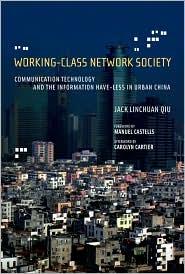
Working-Class Network Society


I will review Working-Class Network Society: Communication Technology and the Information Have-Less in Urban China by Jack Linchuan Qiu.

Qiu breaks down the dichotomy of the information "haves" and "have-nots" by introducing the information "have-less." He defines this group as "migrants, laid-off workers, micro-entrepreneurs, retirees, youth, and others, increasingly connected by cybercafes, prepaid service, and used mobile phones" (MIT Press website). He goes on to discuss how China's economy is being affected by the introduction of inexpensive technology and the "network labor" of the new working class.

Sunday, March 08, 2009

Generation Digital

I will review Generation Digital: Politics, Commerce, and Childhood in the Age of the Internet by Kathryn C. Montgomery.

In this book Montgomery looks at the so-called "digital generation" and the different ways they are viewed by adults in our society ("bold trailblazers and innocent victims, as active creators of digital culture and passive targets of digital marketing").

Stuck in the Shallow End


I will review Stuck in the Shallow End: education, race and computing by Jane Margolis.

The book focuses on the technology curriculum of three high schools in the Los Angeles metro area. Margolis is a Harvard PhD,who is currently at UCLA's School of Education and Information Science department. A chapter from this book was included in our previous readings. I was intrigued by the the author's treatment of technology education and students of color and decided to delved deeper into these issues.

Saturday, March 07, 2009

Book Review Selection


For my book review, I've selected Jane Margolis and Allan Fisher's "Unlocking the Clubhouse: Women in Computing." I enjoyed the excerpt on East River High that Margolis wrote and decided to find something else that had to do with education. This book looks at why women continue to be underrepresented in tech fields, either in schools or in the workplace. I haven't started it quite yet but it seems pretty interesting. The book specifically looks at two areas: why interest in technology seems to fade as girls reach middle school and why those female students who do enroll in tech programs at colleges/universities are less likely to stay with the major and get jobs in the field. Part of their research was conducting interviews with about 250 women enrolled in the computer science program at Carnegie Mellon. I'm excited to read it!

we choose to disseminate culture.


over at torrentfreak there's a really good response/commentary to the fan subtitling issues i brought up the other day

Fansubbers Are Not Thieves, But Avid Consumers

the issue at hand is not that people are not willing to pay for their movies, but that the crowdsourced subtitles areable to satisfy viewers much quicker than the corporations are able to provide the language specific content.


"We could be killing, we could be stealing. But no. We choose to disseminate culture. The subtitles we make are not what makes DVD sales fall, it’s their abusive high prices.

The long delay between the airing of a series in its country of origin and the rest of the world is the number one reason why people choose to download - the wait for the series to reach non-cable TV can take years!

Years to find out what happened with: The island people! Jack Bauer! Hiro Nakamura! Michael Scofield! True fans always try to buy the original products and many series owners got to know about these through the Internet. Today they are collectors."

Friday, March 06, 2009

"The Wisdom of the Chaperones"


talking about wikipedia and the percentages of users got me thinking about this slate article from a while about a year ago:

The Wisdom of the Chaperones

the idea that 1 percent of the wikipedia users are responsible for almost half of the overall content is somewhat distressing. as the article points out, the trend continues when expanded out to include other so-called democratizing web 2.0 technologies such as digg.

"Despite the fairy tales about the participatory culture of Web 2.0, direct democracy isn't feasible at the scale on which these sites operate."

"Digg and Wikipedia would do well to stop pretending they're operated by the many and start thinking of ways to rein in the power of the few."

My Book - Digital Disability


I'm planning to read Goggin & Newell's Digital Disability: the Social Construction of Disability in New Media.

These two are working in the Australian context, but their work has been the best I've seen in analyzing how new media culture and policies reinforce differences in ability, excluding those commonly regarded as having mental or physical disabilities as well as those who are "disabled" in the context of digital technology due to their inability to use the very specific tools that are required. I've only read their article on mobile phones, so I'm very excited to read the book!

Since Americans with disabilities go online at roughly half the rate of Americans who do not identify as having a disability, understanding the cultural and societal context for these differences would seem to be important in bridging that particular digital divide.

Finally, I look forward to the alliterative possibilities - Double the Digital Disability Divide!

Grooming & My Book


I imagine Facebook will continue to be the subject of study in the years to come. Here's an interesting, short article that uses science to analyze Facebook interaction. It's the neocortex divide.

Also, I'm going to read the book Virtual Inequality: Beyond the Digital Divide by Karen Mossberger, Caroline J. Tolbert, and Mary Stansbury. I liked their model in the reading we did a few weeks back, creating a hierarchy or sorts, access, skills, economic opportunity, and democracy. It looks like they break the chapters down this way too, devoting a chapter a piece to each categorical divide. They also end with a chapter on opportunities to close the divide in the future, so I like it's organization, its symmetry. Now all I have to do is get reading. Oh, and a drawback of having the Kindle version is that it doesn't have page numbers, which I'd like to have for citation purposes, so I've got this print version too, sooo old school.

Thursday, March 05, 2009

12 “Dead Technology” Advertisements


we've been talking a lot about ads for technology, and this popped up over at neatorama, so i will share it since that is what the internet does best

dead tech ads

minidiscs and beepers and neo-geo, oh my!

note: i'm not quite sure how john updike's death relates to this.

"Each of us is a minority of one"

Kenneth Starr made the argument today in the California Supreme Court that the fundamental rights embodied in the California Constitution are subject to the will of the majority, and that thus the protections offered to minorities via the constitution are subject to amendment and curtailment based on popular vote.

Quote: "Each of us is a minority of one".

Hmm..talk about making issues of race, class and sexuality invisible.

http://www.calchannel.com/

RaceFail 2009

If anyone is curious about the LiveJournal/sff fandom race discussion mentioned in class, rydra_wong has been posting link roundups for a while now. Here's the original overview, which covers the early stages of the debate.

Edit: Actually it looks like that second link I posted covers discussions of race in fandom generally. Still interesting, but less specific.

"Anti-Piracy Action Closes Yet More Fansub Sites"


we mentioned content translations briefly today, and it made me think about this story from torrent freak about fan-subtitling sites from around the world getting shuttered.

Anti-Piracy Action Closes Yet More Fansub Sites

i'm not entirely certain of the content transactions that take place vie these sites, but it seems apparent that all they're doing is providing a crowd-sourced collection of subtitles and not actually linking to any copyrighted video content, though this isn't to say that the subtitles aren't copyrighted (they most certainly are).

there's no way i'm going to be able to make sense of this site, but i'm pretty sure it's one of the sub-titling sites that is still up and running.

Anthropological Introduction to Youtube

http://mediatedcultures.net/youtube.htm

Wednesday, March 04, 2009

Reading Race Online: Discovering racial identity in Usenet discussions (article summary)

The author, Bryon Burkhalter, first tries to establish a working definition of race. It is described as “a biological phenomenon in which societies invest social meaning.” Determining racial identity of others usually relies primarily on physical characteristics of other individual such as skin color and vocal patterns. He states that knowing someones race is useful because “it provides for stereotypical understandings based on a racially immutable body” and that “it's a reliable social resource.” Burkhalter maintains that online racial identification is not lacking even with the removal of physical cues and that “racial identity is a feature of many online interactions.”

For his research, Burhalter primarily focused on several Usenet groups that were centered around racial culture. Users in these groups often self-identify through several different means including stating their racial “category”, by using vernacular expressions, as well as mentioning their parents, heritage, hometown etc. Burhalter has determined that users of these forums identify themselves in an organized way through their ongoing discussions. Rather than online users being unsure of each others races while in communication online, he believes that users are certain of each others racial identities and that in general do not indicate they are unsure or distrustful of each other. Cues to racial identification are carried along with the users stated “perspectives on racial issues.” One outcome of this physical disconnect is that if another user makes a statement which another views as a discrepancy, the reader can adjust their view of the identity of the other user to fit their perspective.

The author then gives a short description of what Usenet newsgroups are. He states that Usenet resembles a “large cocktail party.” Here is a link to a FAQ on Usenet: http://www.faqs.org/faqs/usenet/what-is/part1/

Some users take the physically anonymous online opportunity to claim a racial identity other than their own. It seems in most cases however that participants are more concerned with being known and in how they are received than in deceiving others. Specific cultural, racial, or ethic terms are sometimes used in subject lines when bringing up a specific topic for discussion to assist in framing the conversation towards a specific audience although this does not assure that race will be relevant though the course of the discussion comments.

Sometimes asserting a specific identity can be disputed and anonymous messages can “undercut the credibility of an author's identity and argument”. In some cases rather than attacking a user's argument, their “claimed social position” is attacked which deflects from the actual discussion of their view. Stereotyping online can work in an almost reverse way from “standard” stereotyping. Rather than determining someones beliefs by their race, one might use someones beliefs to help determine a persons race in an online interaction. Race is still relevant online and stereotypes flourish in Usenet environments.

Free Press Documentary Series on Broadband Internet

Free Press went to North Carolina recently, and interviewed people in rural areas about how their lack of access to broadband internet service was hurting their economic opportunities and connection to the outside world.

Very interesting stuff, connected to the Internet for Everyone project, which advocates for broadband expansion as a necessary service, like water or telephony.

Monday, March 02, 2009

Upcoming lecture of interest (right after class!)

While putting together next week's campus events digest, I came across this lecture up in Social Sciences. Anyone up for a brown-bag?

THE EFFECTS OF HOME COMPUTERS ON EDUCATIONAL OUTCOMES

WHEN AND WHERE: Thursday, March 12, 12:15 p.m., 8417 Sewell Social Sciences

DETAILS: Robert Fairlie, University of California, Santa Cruz, will discuss his research on the digital divide, welfare reform and the U.S. educational system, featuring evidence from a field experiment with low-income community college students.

RELATED LINK: http://www.lafollette.wisc.edu

CONTACT: 608-262-3038, shelton@lafollette.wisc.edu

Sunday, March 01, 2009

Conference on Social Justice

I just received a notification about a conference on social justice sponsored by several students in the L&S Honors Program on campus. It will be held April 24-25. Considering our conversation last week on the disparity of technology between departments, not to mention issues of equality and equity, I thought some of the class may be interested in attending and/or participating in the forums.